by Farley Webmaster | Jun 11, 2019
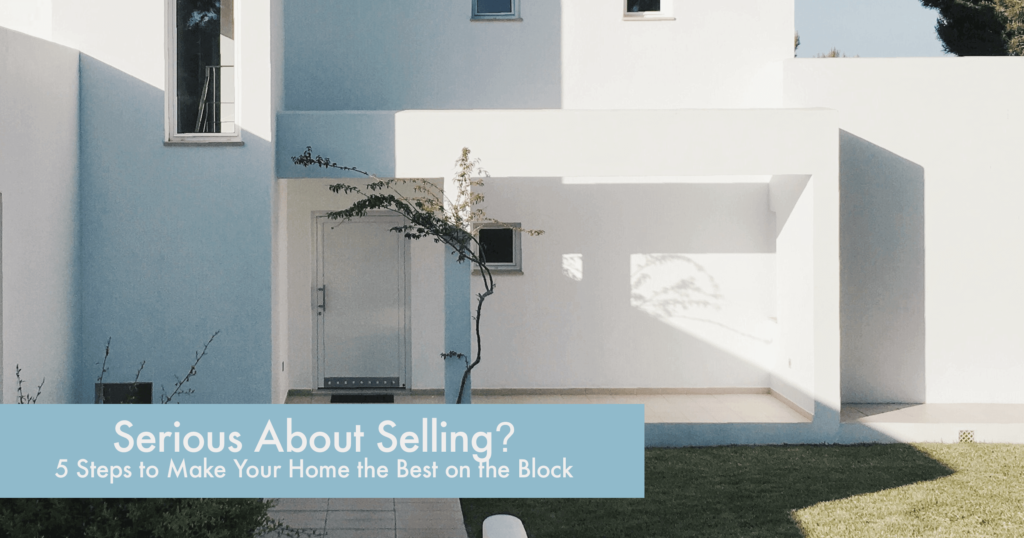
We all want to be good neighbors. But when it comes to selling your home, it’s not just about “keeping up with the Joneses.” It’s about outshining them at every opportunity!
If you’re looking to sell your home fast and for the most money possible, you’ll need a strategy to set it apart from all the other listings competing for buyers in your area. That’s why we’ve outlined our proven, five-step plan for serious sellers.
Use these five tactics to help your listing get noticed, win over buyers, and net a higher sales price than your neighbors!
STEP 1: Stage Your Home to Show Its Full Potential
The average seller will do the minimum to prepare their home for market: clean and declutter, fix anything that’s broken, mow the lawn. And while those tasks are essential, today’s buyers want more than just a clean house and tidy yard. When they dream of buying a new home, they envision a designer house with modern finishes. Help them see your property’s full potential by staging it.
Home staging is one of the hottest trends in real estate—because it works! According to the Real Estate Staging Association, homes that are professionally staged spend 73% less time on the market.1
So what exactly is staging? In a broad sense, staging is the act of preparing your home for market. The goal is to highlight your home’s strengths, minimize any deficiencies, and help buyers envision themselves living in the space. When staging a home, you might rearrange the furniture to make a room feel larger or remove heavy curtains to make it appear brighter.
Some sellers choose to hire a professional home stager, who has specialized training and experience, to maximize the appeal of their home to the largest number of potential buyers. Others may opt to do it themselves, using guidance from their agent.
We can help you determine the appropriate budget and effort required to push your home ahead of the competition in your neighborhood. The good news is, an investment in staging pays off. A 2018 survey found that 85% of staged homes sold for 6-25% more than their unstaged neighbors homes.2
STEP 2: Draw Buyers in with High-Quality Listing Photos
You only have one chance to make a first impression with potential buyers. And many buyers will view photos of a listing before they decide whether or not to visit it in person. In fact, 87% of buyers find photos “very useful” in their home search.3 Poor-quality or amateur-looking listing photos could keep buyers from ever stepping through your door.
Since good photography plays such an important role in getting your property noticed, we only work with the top local professionals to photograph our listings. But we don’t just rely on their photography skills when it comes to showcasing your home.
We go the extra mile to ensure your listing photos showcase the true essence of your home. We’re always on site during the photo shoot to help the photographer capture the best angles and lighting, and to let them know about unique or compelling selling features that they should photograph. The extra effort pays off in the end. In fact, listings with high-quality photography sell 32% faster than the competition … and often for more money!4
STEP 3: Price It Properly From the Start
Even in a strong real estate market, there are homes that will sit unsold for months on end. This can be the “kiss of death” in real estate, as buyers tend to imagine that there must be something wrong with the property, even if it’s not the case.
But why are those houses still on the market in the first place? It’s because they are often priced too high.
Every buyer has a budget. And most will be viewing listings within a particular price range. If your property is overpriced, it can’t properly compete with the other houses they’re viewing that are priced correctly. Which means it’ll sit on the market until you’re eventually forced to drop the price.
Alternatively, if you price your home aggressively, it can be among the nicest homes that buyers have seen within their budget. This can lead to emotionally-attached buyers, who are often willing to pay a premium or settle for fewer seller concessions. And in certain markets, it can lead to a multiple-offer situation, or bidding war. The end result? More money in your pocket.
We can help you determine the ideal listing price for your home in the current market. Pricing it properly in the beginning is the best way to ensure a fast and profitable sale.
STEP 4: Put on a Good Show at Each Showing
Once buyers are interested enough to schedule a visit, it’s crucial that you put on a good show at each showing.
The first step is to make your home readily available—and often on short notice—for buyers to see it. A missed showing is a missed opportunity to sell your home. If you set too many restrictions on when it’s available to view, busy buyers will simply skip over your listing and move on to the next one.
Part of making your home available means keeping it relatively show-ready as long as it’s on the market. Most of us don’t live picture-perfect lives, and our homes reflect the day-to-day reality of our busy (and sometimes messy) families. But a little extra effort spent keeping your home clean, fresh-smelling, and ready for buyers will help it sell faster … which means you can get back to your regular routine as quickly as possible!
STEP 5: Use a Proven Promotion Plan
Most agents are still marketing their listings like they did 20 years ago … put a sign in the yard, put the listing in the MLS, and pray that it sells. Yet, we know that 93% of buyers search for real estate listings online.3
That’s why we invest in the latest training and technology—to ensure your listing appears in the places where buyers are most likely to look. Our dual-level promotion strategy includes both pre-launch activities designed to seed the marketplace and post-listing activities to ensure your home stays top-of-mind with potential buyers.
By utilizing online and social marketing platforms to connect with consumers and offline channels to connect with local real estate agents, your property gets maximum exposure to prospective buyers.
LET’S GET MOVING
Are you thinking about listing your home? Get a head start on your competition! Contact us for a copy of our Home Seller’s Guide, which offers a complete guide to the home selling process. Or call us to schedule a free no-commitment consultation. We’d love to put together a custom plan to maximize the sales potential of your property!
Sources:
- Real Estate Staging Association – https://www.realestatestagingassociation.com/content.aspx?page_id=22&club_id=304550&module_id=164548
- Home Staging Resources –
https://www.homestagingresources.com/2018-home-staging-statistics/
- National Association of Realtors –
https://www.nar.realtor/sites/default/files/documents/2018-real-estate-in-a-digital-world-12-12-2018.pdf
- RIS Media –
https://rismedia.com/2018/12/12/shocking-stats-importance-photography-real-estate/
by John Farley | Oct 28, 2016
What is Home Equity?
Home equity seems to be a very simple calculation — the total amount of mortgages owed subtracted from the current market value of a home. Here is a simple example:
Current Home Market Value $325,000
Existing Mortgage $225,000
Homeowner Equity $100,000
One side of the equation is well defined, and it is found on the monthly mortgage statement, the loan balance. The other side is less obvious — the current market value of the property.
As a homeowner, your down payment purchases your initial equity, and your monthly (or additional) principal payments increase your equity. In strong real estate markets and in-demand locations, equity can increase quite rapidly as the property value increases, but the inverse can also happen — too much available inventory and market down-cycles can lead to falling home values and a reduction in homeowner equity.
It can be difficult to put an accurate value on something that you have emotional and monetary vesting in. It is safe to say that most people think their home is worth more than then it is.
Homeowners can make savvy assessments about their home’s current market value by following the sales of similar properties in the neighborhood, but should stay away from websites such as Zillow and Trulia, which provide inaccurate and outdated estimates. The most accurate measurement requires a comparative market analysis from a real estate professional or having the home professionally appraised. But, the bottom line — your home is worth as much as someone is willing to pay for it.
Creating Value is in Your Hands
Maintaining the condition of a home is vitally important to retaining and increasing value. Homes are judged against their peers: how they compare to similar homes in the neighborhood. Another way to retain value is to not over upgrade, since it is rare to ever recoup the money spent if you exceed neighborhood value. Keep up the landscaping and do the little things to add curb appeal.
Putting Home Equity to Work
Home equity represents the largest single asset of millions of people, and because it represents so much of an individual’s net worth, it must be treated with respect. Home equity is not a liquid asset until a property is sold, or it is borrowed against.
There are two types of loans that tap into homeowner equity as collateral.
Home Equity Loans
Many home equity plans set a fixed period during which the person can borrow money, such as 10 years. At the end of this “draw period,” the person may be allowed to renew the credit line. If the plan does not allow renewals, the homeowner will not be able to borrow additional money once the period has ended. Some plans may call for payment in full of any outstanding balance at the end of the period. Others may allow repayment over a fixed period, for example, of 10 years.
A home equity loan, sometimes called a second mortgage, usually has a fixed rate and a set time to pay it back, generally with equal monthly payments.
Home Equity Line of Credit
A home equity line of credit is similar to a credit card. The lender sets a maximum amount you can borrow, and you can draw money as you need it, though many home equity lines of credit require an initial draw. The interest rate varies daily, and is usually prime plus a set number, but the required payment is usually interest only. Once the loan has been paid down, the payment is reduced, and it can be paid off and initiated as many times as a homeowner requires.
How Much Equity can be Accessed?
Since the financial institution is lending money and using a home as collateral, they will not lend 100% of the home’s equity. The bank does not want to take the risk that if the house price drops, they would be carrying a loan for more than its market value. Therefore, most banks will allow a qualified homeowner to borrow approximately 80% of their equity.
It’s Important to Use Your Home Equity Wisely
Because it is likely the biggest asset most people have, losing your home equity is hard to overcome. It must be used in prudent ways, and the payments against the loan must be affordable. Using equity money to make the loan payment is only acceptable for a short-term solution.
There are number of good reasons to use money from a home equity loan… and some really bad ones. First, let’s cover smart uses.
1. Invest in Your Home
The best way to use the money is create more equity in the home. Among the very best returns on your investment (ROI) include kitchen and bathroom remodels, adding square footage or an extra bath, enhancing curb appeal and repairing/keeping the existing structure sound. Making prudent investments in your home is a wonderful win-win: you enjoy the upgrades and the repairs can add value to the home.
2. Invest in your Children’s Education
Using your home equity to finance a child’s higher education may be the greatest payoff of all. Not only is the rate much lower than a student loan, it is an investment in the child’s future.
3. Supplement Retirement Needs
Older homeowners spent their working lives paying down their mortgage. At retirement, when monthly income is reduced, a home equity loan could pay for a dream vacation or an unexpected major expense.
4. Augment the Impending Sale of a Home
If you’re planning to sell soon, a home equity line of credit may be the best way to finance improvements, and you can pay it off entirely when you sell. Investing wisely on upgrades and repairs may even reap a profit on your investment.
Here are some examples of some not very wise choices.
Adding luxury amenities like a swimming pool, a hot spa, lavish landscaping, expensive appliances and exotic countertops and flooring rarely pay off.
Purchasing a car or boat or most any personal luxury items is a poor use of the funds, since these items quickly depreciate in value.
Also stay away from using money on risk-heavy investments. Financing stock purchases, start-up businesses and paying routine bills is not financially smart. If you cannot afford to purchase those items with available funds, using equity from your home means they should not be in your budget.
You should treat a home equity loan as an investment and not as extra cash when making financial decisions. If your intended use of the money doesn’t pay you back in some way, it’s not the best use of your valuable equity.
We Are Happy to Assist You
If you would like an assessment of the market value of your home and the current equity you can access, give us a call at 303-475-6269 or email 2johnfarley@gmail.com for a comparative market analysis.
by Farley Webmaster | Apr 28, 2016

Whether you’re putting your home on the market this year or in the next five years, it is a smart decision to start building your home’s resale value now. Here are some ways to create a comfortable home while making it easier to put more money into your bank account on closing day.
Small Maintenance and Repairs
If you think that home maintenance on the weekends waste your time and energy, think again. The small chores you do around your home prevents it from losing value. Neglecting small maintenance and repairs causes 10% of your home’s value to walk out your door and slip through your windows. Most appraisers claim that homes showing little to no preventative maintenance can depreciate from $15,000 to $20,000.
A study conducted by researchers at the University of Connecticut and Syracuse University shows that regular maintenance boosts your home value by about 1% per year. However, ongoing maintenance costs offset that value, which means that regular maintenance actually slows down your rate of depreciation. Furthermore, because homebuyers generally notice any repairs needed upon buying a new home, proactive maintenance lets the homebuyer know that he or she will not have to spend extra money to maintain the basics. This makes your home more attractive, and thus more likely to get higher priced offers.
Maintaining the basics can cost you little money and certainly some effort, but there’s a way to accomplish this very important activity smartly. This article by HouseLogic, for example, shows you how to keep home maintenance below $300 a year. Planning ahead will also help make maintaining your home easier. Most professional appraisers and real estate agents recommend a proactive maintenance schedule that includes:
- Keeping enough cash on hand to replace systems and materials
- Creating and following a maintenance schedule
- Planning a room redo every year
- Keeping a notebook of all your maintenance and repairs
Landscaping
The Virginia Cooperative Extension at Virginia Tech published a study that shows landscaping can increase a home’s value by 15%. The study claims that a home valued at $150,000 could increase its value between $8,300 and $19,000 with the addition of landscaping. Particular landscape elements add different value. For instance, landscape design can increase your home’s value by 42%, plant size can increase your home’s value by 32%, and diversity in plants can increase your home’s value by 22%.
Replace Entrance Doors
If your entry doors are wood, consider switching them out for either fiberglass or steel doors. Steel doors add style and architectural interest to your home while improving security; you can add a deadbolt and electronic keypads to keep out intruders. Unlike wood doors, steel doors do not rot or splinter.
Alternatively, fiberglass doors can be designed to look like wood doors and give your home a modern look. Fiberglass doors conserve more energy than steel doors.
Pricewise, a steel door will cost you $1,335 with a 91% return on investment whereas a fiberglass door will cost you $3,126 with an 82.3% return on investment.
Garage Door Replacement
At first, you might not think that your garage door increases the value of your home. However, your garage door distinguishes your home from the other homes on your block. As the largest entryway of a house, garage doors get noticed first because they’re the focal point of your home. If you want to quickly increase the resale value of your home, you need to make the most of this space.
Some interesting things being done with garage doors include:
- Increased Size: Bigger garage doors help homes stand out more, and homeowners can do more creatively with them.
- Bold Colors: Bright and bold colors now can complement the color of your home, or you can build a concept around the color of your home.
- Faux Wood: You can install fiberglass or steel garage doors that look like wood garage doors. This gives your home a new level of sophistication.
- Windows: Large Windows on your garage door improve the aesthetic of your home, and provide light into your garage so that it’s no longer a dark space.
More importantly, a garage door replacement will cost you $1,652 and add $1,512 to the value of your home; that’s a return on your investment of 91.5%.
Fiberglass Attic Insulation
While energy efficiency is still not the sexiest selling point of your home, installing fiberglass attic insulation saves energy and garners a big payback on your investment. According to Remodeling Magazine’s 2016 Cost vs. Value top trends report, fiberglass attic insulation gained the top return on investment among the 30 projects in this year’s report. Using Remodel/Max as the cost source, a fiberglass attic insulation project cost $1,268 nationwide. Real estate professionals surveyed estimated that the work would boost the price of a home at resale, within a year of its completion, by $1,482. That’s a 116.9% return on investment.
Replacing Windows
Replacing your windows is another way to save energy and increase your home’s resale value. Replacing your old windows with energy saving models will beautify your home, keep it comfortable, and ease the workload of your HVAC system. According to HGTV, you’ll see a reduction in your utility bill by 7% to 15%. However, if you’re selling your home, you could expect a 60% to 70% recoupment of your investment. The two types of replacement windows that fetch the best return are vinyl and wood.
Remodeling Your Kitchen
Kitchen remodeling can get expensive, but small renovations can make your home more buyer friendly. Changing your kitchen’s texture and color using a matte finish and neutral colors such as putty or grey enhances your home’s resale value. Because matte finishes have transitional qualities, your potential homebuyer can easily match his or her stainless steel or black and white appliances. Also, refinishing cabinetry, or switching to Energy Star™ appliances provide comfort you like and pizazz buyers adore.
Flow is important to any interior design of a home. If you feel that your kitchen hinders a good flow, change it. A small investment to knock out a non-structural wall or remove a kitchen island creates space and provides flow that buyers love.
A minor kitchen remodel can cost you $20,122 while putting $16,716 of resale value into your home; that’s an 83% payback on the project. If you want to do a major kitchen model, this can cost you about $60,000 and put about $39,000 of resale value into your home, which is only about a 65% payback on the project. Therefore, consider a minor kitchen remodel first.
Bathroom Addition or Remodel
Likewise, carefully consider adding a bathroom or remodeling your bathroom. Switching out your frosted glass shower doors for glass doors, cleaning the grout, replacing the shower and floor tiles, switching out your sink or toilet, or replacing your sink and shower fixtures can cost you little money.
Adding a bathroom can get expensive, but it can reduce congestion during hectic times and provide your guests with a bathroom. Consult with your real estate agent or a local appraiser before deciding whether a full remodel or addition is right for your situation. While a bathroom remodel will cost you about $18,000 with a return on investment of about 66%, a bathroom addition will cost you about $42,000 with a return on investment of about 56%. Therefore, it’s best do your due diligence before working on your bathroom.
Your Needs and Buyers’ Wants
On that note, if you need to renovate your home, be sure to consider how those changes will affect its appeal to future buyers. Knowing design trends will give you the opportunity to make changes to your home based on where your needs and your potential buyer’s desires intersect, thus increasing your property’s resale value drastically.
Designers and design websites provide great ideas when you’re brainstorming home renovations. Keep in mind as you research, however, that you don’t want to sacrifice your needs for a comfortable home just for the sake of what you think a future buyer will want!
Therefore, before you begin making any changes to your home, consult your real estate agent. Real estate agents, because we are constantly working with new buyer clients, have insider insight into what home buyers are looking for now and in the future. We’ll be able to help you make smart choices when remodeling or renovating your home.
If you think you might want to remodel or renovate your home in the near future, or if you are just curious about other ways you can increase its resale value, please reach out to me!