National Snapshot: What’s Ahead for Real Estate

National Snapshot: What’s Ahead for Real Estate

The U.S. unemployment rate is at a 50-year low, and consumer confidence remains high. In fact, the University of Michigan’s latest Surveys of Consumers found that Americans have their most positive personal finance outlook since 2003.1

However, if you follow national news, you’ve probably heard speculation that we could be headed toward a recession. Global trade tensions and a slow down in the GDP growth rate has sparked volatility in the stock market, leading to economic uncertainty.

Given these differing signals, you may be wondering: How has the U.S. housing market been impacted? Where is it headed? And more importantly … what does it mean for me?


MORTGAGE RATES ARE NEAR HISTORIC LOWS

In August, Freddie Mac reported that the average 30-year fixed mortgage rate hit its lowest level since November 2016, falling to 3.6%, down a full percentage point from a year earlier.2 Variable mortgage rates also fell when the Federal Reserve cut interest rates at the end of July for the first time since 2008.3

This was welcome news for many in the real estate industry. Freddie Mac predicts that low interest rates and a robust job market will help the housing market remain strong despite the threat of recession.

“There is a tug of war in the financial markets between weaker business sentiment and consumer sentiment,” said Sam Khater, Freddie Mac’s chief economist. “Business sentiment is declining on negative trade and manufacturing headlines, but consumer sentiment remains buoyed by a strong labor market and low rates that will continue to drive home sales into the fall.”2

What does it mean for you?

If you’re looking to buy a home, now is a great time to lock in a low mortgage rate. It will shrink your monthly payment and could save you a bundle over the long term. Or if you plan to stay in your current home for a while, consider whether it makes sense to refinance your mortgage at today’s lower rates.


PRICES CONTINUE TO RISE AT A MODEST PACE

According to the S&P CoreLogic Case-Shiller Indices, housing prices continue to rise. But the rate at which prices are rising is slowing down. For May 2019, the National Home Price Index rose by 3.4%, down from 3.5% the previous month.4

Of course, national averages often don’t present the whole picture. Some markets have seen modest declines, while other areas are witnessing double-digit increases. The key differentiating factor in most cases? Housing affordability.5

Since 2012, home prices have increased at about three times the pace of wages, according to National Association of Realtors chief economist Lawrence Yun.6

“Housing unaffordability will hinder sales irrespective of the local job market conditions,” said Yun. “This is evident in the very expensive markets as home prices are either topping off or slightly falling.”5

But what about all this talk of a recession? Will we see housing values plummet like they did in 2008? Economists say no.

If we look at history, the real estate crash experienced during the Great Recession isn’t typical.

The recent Housing and Mortgage Market Review report from Arch Mortgage Insurance provides data to support this. “What we found is that the next recession is likely to be far less severe on the housing market than the last one. It’s not that this time is different; it’s that last time was really different from historic norms.”6

“A large decline in national home prices is unlikely in the next recession,” Arch economists write. “A persistent housing shortage should help cushion home price declines.”6

What does it mean for you?

If you have the ability and desire to buy a home now, don’t let the threat of a recession hold you in limbo. The market is cyclical, and it will experience ups and downs. But over the long term, real estate has consistently proven to be a good investment.

 

STARTER INVENTORY REMAINS TIGHT WHILE LUXURY MARKET SOFTENS

As we’ve seen in the past, it’s become a tale of two sectors.

The low-end of the market remains highly competitive as buyers compete for affordable housing. A lack of new construction during the last recession led to an undersupply of starter homes. This trend continues—despite growing demand—due to a lack of skilled workers, rising land and material costs, and a slow permitting process in many areas.7

The result? There’s a shortage of homes for sale that Americans can actually afford to buy.

The luxury market, on the other hand, has softened. Economic uncertainty, changes to tax laws, and rising prices have slowed demand. Plus, to recoup their higher costs, builders flocked to this segment—causing an overabundance of supply in some areas.

“If you’re selling an entry level home, you’re probably still looking at a pretty competitive market in most places,” according to Danielle Hale, chief economist at Realtor.com. “But if you’re selling a more expensive home you probably have to adjust your expectations.”8

What does it mean for you?

Move-up buyers, you’re in luck! If you’re ready to trade in your starter home for something more luxurious, you may get the best of both sectors. We’re still witnessing strong demand for entry-level homes, giving sellers the upper hand. At the same time, buyers of high-end homes are finding a greater selection (and more negotiating power) than they’ve had in years.

INVESTORS ARE BUYING HOMES AT RECORD LEVELS

There’s one group that hasn’t been slowed down by lack of affordability or economic uncertainty: investors.

According to CoreLogic, investors are purchasing homes at a record pace. In 2018, the share of U.S. homes bought by investors reached 11.3%—the highest level since the company began tracking nearly 20 years ago.9

Notably, this increased activity wasn’t led by institutional investors, but instead by small and individual investors focused on the starter-home segment.7 Declining interest rates and an uncertain stock market has led investors to flock to real estate as they seek out greater stability and higher returns.

“With declining mortgage rates … they’re searching for a better return for their money,” said NAR chief economist Lawrence Yun.10

What does it mean for you?

If you’re looking for a way to “recession proof” your money, you might want to consider investing in real estate. People will always need a place to live, and (unlike the stock market) a rental property can provide a steady source of cash flow during uncertain economic times.

WE’RE HERE TO GUIDE YOU

While national real estate numbers can provide a “big picture” outlook, real estate is local. As Boulder real estate market experts, we can guide you through the ins and outs of our market and the issues most likely to impact sales and home values in your particular neighborhood.

If you have specific questions or would like more information about how market changes could affect you, contact us to schedule a free consultation. We’re here to help you navigate this shifting real estate landscape.

Sources:

  1. University of Michigan Surveys of Consumers – http://www.sca.isr.umich.edu/
  2. Freddie Mac – https://freddiemac.gcs-web.com/news-releases/news-release-details/mortgage-rates-drop-significantly?_ga=2.29332539.689041222.1565464527-928629548.1565464527
  3. CNN – https://www.cnn.com/2019/07/31/business/fed-rate-cut-july-meeting/index.html
  4. S&P Dow Jones Indices – https://us.spindices.com/documents/indexnews/announcements/20190730-965771/965771_cshomeprice-release-0730.pdf?force_download=true
  5. National Association of Realtors – https://www.nar.realtor/newsroom/metro-home-prices-increase-in-91-of-metro-areas-in-second-quarter-of-2019
  6. Forbes – https://www.forbes.com/sites/alyyale/2019/04/18/with-a-recession-looming-is-now-the-time-to-sell-your-home/#7d3a21665bce
  7. CNN – https://www.cnn.com/2019/08/09/economy/mortgages-home-buyers/index.html
  8. Forbes – https://www.forbes.com/sites/carolinefeeney/2019/07/01/halfway-into-2019-how-is-the-housing-market-holding-up/#7e656e3ec5d8
  9. CoreLogic – https://www.corelogic.com/blog/2019/06/special-report-investor-home-buying.aspx
  10. Fox Business – https://www.foxbusiness.com/economy/investors-snapping-up-homes-at-record-levels
What’s Your Home Actually Worth?

What's Your Home Actually Worth? | Farley Boulder Real Estate


It’s easy to look up how much money you have in your savings account or the real-time value of your stock investments. But determining the dollar value of a home is trickier.

As a seller, knowing your home’s worth helps you price it correctly when you put it up for sale. If you price it too high, it may sit on the market. But price it too low and you may be losing out on a good chunk of money (nobody wants that!). For buyers, it’s important to know a home’s worth before you make an offer. You want your offer to be competitive, but you don’t want to overpay for the property.

Even if you’re not a buyer or seller right now, as a current homeowner you might just be curious about the value of your home. Keeping track of your home’s worth year over year helps you understand the trends in your market. So when you are ready to sell, you can take advantage of a good window of opportunity.

The good news is, a trained real estate agent—who understands the nuances of your particular neighborhood—can determine the true market value of your property … and at no cost to you!


THE THREE TYPES OF HOME VALUES

When you start the process of buying or selling a home, you’ll frequently hear the words appraised value, assessed value, and true market value. It’s important to know the difference between each one so you can make better, informed decisions.

Appraised Value

A professional appraiser is in charge of determining the appraised value of a home. These appraisals are typically required by a lender when a buyer is financing the property. And while the lender is the one requiring this information, the appraiser does not work for the lender.1Your appraiser should be an objective, licensed professional who doesn’t have allegiance to the buyer, seller, or lender—no matter who is paying their fee.

The number the appraiser comes up with (the appraised value) assures the lender that the buyer is not overpaying for the property. For example, imagine a seller lists a home for $400,000. They reach a deal with the buyer to sell the home for $375,000. However, if an appraiser evaluates the property and determines that the appraised value is actually $325,000, then the lender will not lend for an amount higher than that appraised value of $325,000.2

When figuring out this number, an appraiser will compare the property to similar homes in your neighborhood, and they’ll evaluate factors such as location, square footage, appliances, upgrades, improvements, and the interior and exterior of the home. 


Assessed Value

The assessed value of a home is determined by your local municipal property assessor. This value matters when your county calculates property taxes each year. The lower your assessed value, the less property tax you’ll pay.3

To come up with this value, your assessor will evaluate what comparable homes in the neighborhood have sold for, the size of your home, age, overall condition, and any improvements or upgrades that have been made. However, most assessors don’t have full access to your home, so their information is limited.

Assessments are done annually to determine how much property tax you owe. Many counties use a multiplier (typically between 60%-80%) to calculate the final assessed value. So, if the assessor determines that the value of the home is $300,000, but the county uses a 70% multiplier, the assessed value of the home would be $210,000 for tax purposes.4

If your assessed value isn’t as high as you envisioned, don’t sweat it. Many homeowners appeal their assessment in favor of a lower valuation so that they can save money on property taxes. If you’re interested in appealing your property tax assessment, let us know. We offer complimentary assistance and would be happy to help you build your case.


True Market Value

True market value is established by your real estate agent. It basically refers to the value that a buyer is willing to pay for the property. A good real estate agent is an expert in determining true market value because they have hands-on experience buying and selling properties. They understand the mindsets of buyers in your market and know what they’ll pay for a desirable house, townhouse, or condo.

As a seller, knowing your true market value is important because it helps you choose how much to list your property for. It can also help you decide if you want to make any improvements to your home before putting it on the market. Your agent can help you figure out which updates and upgrades will have the biggest impact on your true market value.


WHAT’S THE DEAL WITH ONLINE CALCULATORS?

When figuring out your home’s value, you might be tempted to see what popular real estate sites like Zillow, Redfin, and Trulia have to say. When you use an online calculator to determine your home’s value on these sites, it is just an estimate. It’s not an actual appraisal or the “true market value.” These sites all have their own algorithms for coming up with their estimates. For example, Zillow comes up with their “Zestimates” by calculating “public and user-submitted data, taking into account special features, location, and market conditions.” 5

These online estimates can be a great starting point for opening up the conversation with your real estate agent about your home’s worth. But even Zillow recommends that you use a real estate agent for coming up with the actual market value of your home. The site says that once you get your “Zestimate,” you should still get “a comparative market analysis from a real estate agent.”

Having an agent involved in this process is essential because they understand the market better than a computer ever could. They’re showing property in your city every single day, and they know the particular preferences of buyers and sellers in the area. Young professionals, large families, empty nesters, and other groups are all looking for different things in a home. A local agent has most likely worked with all of them, so they understand what every segment in your market is specifically looking for.


HOW AN AGENT FINDS YOUR HOME’S TRUE MARKET VALUE

So, how does an actual real estate agent determine true market value? They’ll start by doing a comparative market analysis (CMA). This means they’ll compare your home’s features to similar properties in your area. For the CMA, the agent looks at the below factors to influence their assessment of your home’s worth:6

  • Neighborhood sales– Your agent will look at similar, recently sold homes in your neighborhood to see what they sold for and what they have in common with your house.
  • The exterior – What does your home look like from the outside? Your agent will factor in curb appeal, the style of the house, the front and backyard, and anything else that impacts how the house looks to everyone walking and driving by.
  • The interior– This is everything inside the walls of the house. Square footage, number of bedrooms and bathrooms, appliances, and more all influence the overall market value.
  • Age of the home – Whether you have a newer or older home affects the number your agent comes up with as part of their assessment.
  • Style of the home – The style of your home is important because buyers in different markets have different tastes. If buyers prefer ranch-style homes and you have one, then your home may sell for a premium (aka more money!).
  • Market trends –Because a local agent has so much experience in your market, they have their finger on the pulse of your area’s trends and know what buyers are willing to pay for a property like yours.
  • Location, location, location– This one’s probably the most obvious. Your agent will think about how popular the area is, how safe it is, and what schools are like.

A computer algorithm simply can’t take all of these factors into account when calculating the value of your home. The reality is, nothing beats the accuracy of a real estate agent or professional appraiser when it comes to determining a home’s true market value


YOUR AGENT IS THERE EVERY STEP OF THE WAY

Determining a home’s true market value is a real estate agent’s forte. If you’re a seller, your agent will help you find your home’s market value so you can list it at the right price.

For buyers, your agent will help you determine the value so you can come up with a fair offer. Your agent can also set up a personalized home search on the Multiple Listing Service (MLS) for you so you’ll receive emails of listings that meet your criteria. This will help you see what’s out there in your city and how properties are being priced.


Get a Complimentary Report With Your Home’s True Market Value

Curious about your home’s true market value? Call us at 303-475-6269 to request a free, no-obligation Comparative Market Analysis to find out exactly how much your home is worth!


Sources:


  1. Chicago Tribune – https://www.chicagotribune.com/suburbs/chi-ugc-article-what-is-the-difference-between-market-value-a-2013-09-30-story.htm
  2. SFGATE – https://homeguides.sfgate.com/market-value-vs-appraised-value-1206.html
  3. ValuePenguin – https://www.valuepenguin.com/mortgages/what-is-the-assessed-value-of-a-house
  4. Movoto – https://www.movoto.com/blog/homeownership/assessed-value-vs-market-value/
  5. Zillow – https://www.zillow.com/how-much-is-my-home-worth/
  6. Realtor(dot)com – https://www.realtor.com/advice/sell/assessed-value-vs-market-value-difference/


Real Home Value Calculator: Assessed Value vs Market Value

Assessed Value versus Market Value in Real Estate

Understanding a home’s true market value is about more than pictures, software assessments and price-per-square-foot. Whether you’re a current homeowner thinking of selling or are house-hunting, it’s crucial you understand what factors affect home valuation. By partnering with a local market expert, sellers will avoid pricing their house out of the market (the kiss of death in real estate) and buyers will ensure they get a good deal on their next home.

So, how do you accurately calculate a home’s value? After all, the value a home is assigned by its town or county and the one it’s given when it’s listed are often dramatically different from one another. Which one is accurate and what does it all mean? Read on to learn more.

Assessed Value vs Market Value: What’s the difference?
When it comes to home value, you’ll often hear two terms, assessed value and market value.

A home’s assessed value is often the lower number of the two, and is the value given by your municipality or county. Investopedia defines assessed value as “the dollar value assigned to a property to measure applicable taxes.”1 Although property tax laws vary, assessors commonly arrive at this number by taking into account the following:

  • What comparable/similar homes are selling for in your area.
  • The value of recent improvements.
  • Income from renting out a room or space on the property.
  • How much it would cost to rebuild on the property.

A home’s market value, or Fair Market Value, is the price a buyer is willing to pay or a seller is willing to accept for a property. A skilled real estate professional will arrive at the value using a variety of metrics, including:

  • External characteristics, such as lot size, home style, the condition of the home and curb appeal.
  • Internal characteristics, such as the number of rooms and their size, the type and condition of the heating or HVAC system, the quality and condition of construction, the flow of the home, etc.
  • The sales price of comparable homes that have sold in your area.
  • Supply and demand; that is, how many buyers and sellers are in the area.
  • Location; that is, the quality and desirability of your neighborhood and other community amenities.

Why are these values often so different? An assessor usually estimates your property’s market value during a reassessment or if you make a physical change or improvement to it.2 As a result, a property may not be reassessed for many years. While your home’s market value may fluctuate with the market, your home’s assessed value is more likely to remain steady.3

What Determines a Home’s Value?
You’ve likely heard the motto of real estate: “Location, location, location.” This means a home’s value relies on its location. While the home and structures on the property will likely depreciate over time, the land beneath it tends to appreciate. Why? Land is in limited supply and a growing population puts increased demand on the housing supply. As a result, values increase.4

Other factors that affect your home’s value include the function and appearance of the property, how well the home and other structures are maintained and whether the home is a lifestyle property, such as a ranch style with mountain views or beach bungalow.

Ultimately, the best indication of a home’s value is the overall supply and demand of the market. This is why we recommend you partner with a real estate professional who takes all of these factors—the assessed value, local market conditions, home features and has physically walked through and experienced your home— into consideration to determine the most accurate market value.

How to determine if a property is comparable to yours.
Both assessed value and market value are partially determined by the sales price of similar, or comparable, homes in the area. To determine if a home is comparable to yours, look for the following characteristics:

  • Lot size
  • Square footage
  • Home style or similar architecture
  • Age
  • Location

While you may not find a home with the same exact characteristics as yours, you’ll likely find a few that are close. To account for any disparity, adjust the sales prices of the comparable properties. Look at the differences between your property and the one in question and determine if the differences increased or decreased the sales price and by how much. For example, if your home has two bathrooms and a similar home only has three, estimate how much that extra bathroom increased the sale price of the similar home. The adjusted sale price is the estimation of what the property would sell for if the properties were exactly the same.2

Where can you find comparable sales?
Fortunately, you can find comparable home sales in a variety of places.2

  • Your local assessor’s office is able to provide a list of recent sales you can browse and compare or a sales history of a particular house, home style or neighborhood.
  • Your municipality. Many cities keep local sales information in their offices or post it online.
  • Online databases, such as a real estate database
  • Your local newspapers may offer some real estate information in the form of quarterly sales reports in the business or real estate sections of the newspaper.
  • Our office. We regularly do Comparable Market Analysis of homes in our local area.

How to calculate your home’s value.
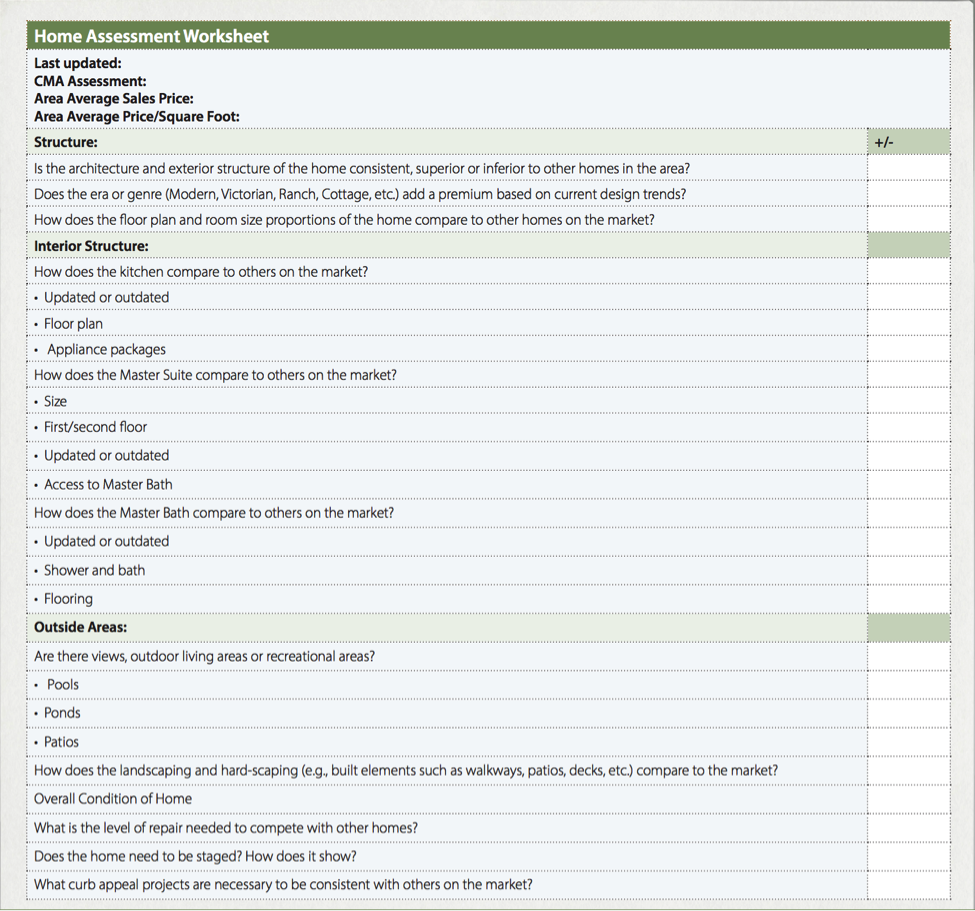
By answering a few questions about your home, property and the local market, you can begin to estimate your property’s value. We’ve also included a worksheet for you below…

Home Value Questions:

When was your home last assessed?

What was its CMA assessment value?

What is your area’s average sales price?

What is your area’s average price/square foot?

Structure:

  • Is the architecture and exterior structure of the home consistent, superior or inferior to other homes in the area?
  • Does the era or genre (Modern, Victorian, Ranch, Cottage, etc.) add a premium based on current design trends?
  • How does the floor plan and room size proportions of the home compare to other homes on the market?

Interior Structure:

  • How does the kitchen compare to others on the market?
    • Updated or outdated
    • Floor plan
    • Appliance packages
  • How does the Master Suite compare to others on the market?
    • Size
    • First/second floor
    • Updated or outdated
    • Access to Master Bath
  • How does the Master Bath compare to others on the market?
    • Updated or outdated
    • Shower and bath
    • Flooring

Outside Areas:

  • Are there views, outdoor living areas or recreational areas?
    • Pools
    • Ponds
    • Patios
  • How does the landscaping and hard-scaping compare to the market? (e.g., built elements such as walkways, patios, decks, etc.)

Overall Condition of Home

  • What is the level of repair needed to compete with other homes?
  • Does the home need to be staged? How does it show?
  • What curb appeal projects are necessary to be consistent with others on the market?


Home Assessment Worksheet

Farley Home Assessment Worksheet


If you want to accurately assess a home’s value, it’s crucial to know about the market activity of our local area. We can help! Give us a call at 303-475-6269 to get the scoop on the local market.

Sources:

  1. Investopedia http://www.investopedia.com/terms/a/assessedvalue.asp
  2. New York State Department of Taxation and Finance https://www.tax.ny.gov/pubs_and_bulls/orpts/mv_estimates.htm
  3. Realtor.com http://www.realtor.com/advice/sell/assessed-value-vs-market-value-difference/
  4. Investopedia, http://www.investopedia.com/articles/mortgages-real-estate/08/housing-appreciation.asp?lgl=myfinance-layout

SaveSave

SaveSave