by Farley Webmaster | Jun 11, 2019

We all want to be good neighbors. But when it comes to selling your home, it’s not just about “keeping up with the Joneses.” It’s about outshining them at every opportunity!
If you’re looking to sell your home fast and for the most money possible, you’ll need a strategy to set it apart from all the other listings competing for buyers in your area. That’s why we’ve outlined our proven, five-step plan for serious sellers.
Use these five tactics to help your listing get noticed, win over buyers, and net a higher sales price than your neighbors!
STEP 1: Stage Your Home to Show Its Full Potential
The average seller will do the minimum to prepare their home for market: clean and declutter, fix anything that’s broken, mow the lawn. And while those tasks are essential, today’s buyers want more than just a clean house and tidy yard. When they dream of buying a new home, they envision a designer house with modern finishes. Help them see your property’s full potential by staging it.
Home staging is one of the hottest trends in real estate—because it works! According to the Real Estate Staging Association, homes that are professionally staged spend 73% less time on the market.1
So what exactly is staging? In a broad sense, staging is the act of preparing your home for market. The goal is to highlight your home’s strengths, minimize any deficiencies, and help buyers envision themselves living in the space. When staging a home, you might rearrange the furniture to make a room feel larger or remove heavy curtains to make it appear brighter.
Some sellers choose to hire a professional home stager, who has specialized training and experience, to maximize the appeal of their home to the largest number of potential buyers. Others may opt to do it themselves, using guidance from their agent.
We can help you determine the appropriate budget and effort required to push your home ahead of the competition in your neighborhood. The good news is, an investment in staging pays off. A 2018 survey found that 85% of staged homes sold for 6-25% more than their unstaged neighbors homes.2
STEP 2: Draw Buyers in with High-Quality Listing Photos
You only have one chance to make a first impression with potential buyers. And many buyers will view photos of a listing before they decide whether or not to visit it in person. In fact, 87% of buyers find photos “very useful” in their home search.3 Poor-quality or amateur-looking listing photos could keep buyers from ever stepping through your door.
Since good photography plays such an important role in getting your property noticed, we only work with the top local professionals to photograph our listings. But we don’t just rely on their photography skills when it comes to showcasing your home.
We go the extra mile to ensure your listing photos showcase the true essence of your home. We’re always on site during the photo shoot to help the photographer capture the best angles and lighting, and to let them know about unique or compelling selling features that they should photograph. The extra effort pays off in the end. In fact, listings with high-quality photography sell 32% faster than the competition … and often for more money!4
STEP 3: Price It Properly From the Start
Even in a strong real estate market, there are homes that will sit unsold for months on end. This can be the “kiss of death” in real estate, as buyers tend to imagine that there must be something wrong with the property, even if it’s not the case.
But why are those houses still on the market in the first place? It’s because they are often priced too high.
Every buyer has a budget. And most will be viewing listings within a particular price range. If your property is overpriced, it can’t properly compete with the other houses they’re viewing that are priced correctly. Which means it’ll sit on the market until you’re eventually forced to drop the price.
Alternatively, if you price your home aggressively, it can be among the nicest homes that buyers have seen within their budget. This can lead to emotionally-attached buyers, who are often willing to pay a premium or settle for fewer seller concessions. And in certain markets, it can lead to a multiple-offer situation, or bidding war. The end result? More money in your pocket.
We can help you determine the ideal listing price for your home in the current market. Pricing it properly in the beginning is the best way to ensure a fast and profitable sale.
STEP 4: Put on a Good Show at Each Showing
Once buyers are interested enough to schedule a visit, it’s crucial that you put on a good show at each showing.
The first step is to make your home readily available—and often on short notice—for buyers to see it. A missed showing is a missed opportunity to sell your home. If you set too many restrictions on when it’s available to view, busy buyers will simply skip over your listing and move on to the next one.
Part of making your home available means keeping it relatively show-ready as long as it’s on the market. Most of us don’t live picture-perfect lives, and our homes reflect the day-to-day reality of our busy (and sometimes messy) families. But a little extra effort spent keeping your home clean, fresh-smelling, and ready for buyers will help it sell faster … which means you can get back to your regular routine as quickly as possible!
STEP 5: Use a Proven Promotion Plan
Most agents are still marketing their listings like they did 20 years ago … put a sign in the yard, put the listing in the MLS, and pray that it sells. Yet, we know that 93% of buyers search for real estate listings online.3
That’s why we invest in the latest training and technology—to ensure your listing appears in the places where buyers are most likely to look. Our dual-level promotion strategy includes both pre-launch activities designed to seed the marketplace and post-listing activities to ensure your home stays top-of-mind with potential buyers.
By utilizing online and social marketing platforms to connect with consumers and offline channels to connect with local real estate agents, your property gets maximum exposure to prospective buyers.
LET’S GET MOVING
Are you thinking about listing your home? Get a head start on your competition! Contact us for a copy of our Home Seller’s Guide, which offers a complete guide to the home selling process. Or call us to schedule a free no-commitment consultation. We’d love to put together a custom plan to maximize the sales potential of your property!
Sources:
- Real Estate Staging Association – https://www.realestatestagingassociation.com/content.aspx?page_id=22&club_id=304550&module_id=164548
- Home Staging Resources –
https://www.homestagingresources.com/2018-home-staging-statistics/
- National Association of Realtors –
https://www.nar.realtor/sites/default/files/documents/2018-real-estate-in-a-digital-world-12-12-2018.pdf
- RIS Media –
https://rismedia.com/2018/12/12/shocking-stats-importance-photography-real-estate/
by Farley Webmaster | Mar 19, 2019
It’s easy to look up how much money you have in your savings account or the real-time value of your stock investments. But determining the dollar value of a home is trickier.
As a seller, knowing your home’s worth helps you price it correctly when you put it up for sale. If you price it too high, it may sit on the market. But price it too low and you may be losing out on a good chunk of money (nobody wants that!). For buyers, it’s important to know a home’s worth before you make an offer. You want your offer to be competitive, but you don’t want to overpay for the property.
Even if you’re not a buyer or seller right now, as a current homeowner you might just be curious about the value of your home. Keeping track of your home’s worth year over year helps you understand the trends in your market. So when you are ready to sell, you can take advantage of a good window of opportunity.
The good news is, a trained real estate agent—who understands the nuances of your particular neighborhood—can determine the true market value of your property … and at no cost to you!
THE THREE TYPES OF HOME VALUES
When you start the process of buying or selling a home, you’ll frequently hear the words appraised value, assessed value, and true market value. It’s important to know the difference between each one so you can make better, informed decisions.
Appraised Value
A professional appraiser is in charge of determining the appraised value of a home. These appraisals are typically required by a lender when a buyer is financing the property. And while the lender is the one requiring this information, the appraiser does not work for the lender.1Your appraiser should be an objective, licensed professional who doesn’t have allegiance to the buyer, seller, or lender—no matter who is paying their fee.
The number the appraiser comes up with (the appraised value) assures the lender that the buyer is not overpaying for the property. For example, imagine a seller lists a home for $400,000. They reach a deal with the buyer to sell the home for $375,000. However, if an appraiser evaluates the property and determines that the appraised value is actually $325,000, then the lender will not lend for an amount higher than that appraised value of $325,000.2
When figuring out this number, an appraiser will compare the property to similar homes in your neighborhood, and they’ll evaluate factors such as location, square footage, appliances, upgrades, improvements, and the interior and exterior of the home.
Assessed Value
The assessed value of a home is determined by your local municipal property assessor. This value matters when your county calculates property taxes each year. The lower your assessed value, the less property tax you’ll pay.3
To come up with this value, your assessor will evaluate what comparable homes in the neighborhood have sold for, the size of your home, age, overall condition, and any improvements or upgrades that have been made. However, most assessors don’t have full access to your home, so their information is limited.
Assessments are done annually to determine how much property tax you owe. Many counties use a multiplier (typically between 60%-80%) to calculate the final assessed value. So, if the assessor determines that the value of the home is $300,000, but the county uses a 70% multiplier, the assessed value of the home would be $210,000 for tax purposes.4
If your assessed value isn’t as high as you envisioned, don’t sweat it. Many homeowners appeal their assessment in favor of a lower valuation so that they can save money on property taxes. If you’re interested in appealing your property tax assessment, let us know. We offer complimentary assistance and would be happy to help you build your case.
True Market Value
True market value is established by your real estate agent. It basically refers to the value that a buyer is willing to pay for the property. A good real estate agent is an expert in determining true market value because they have hands-on experience buying and selling properties. They understand the mindsets of buyers in your market and know what they’ll pay for a desirable house, townhouse, or condo.
As a seller, knowing your true market value is important because it helps you choose how much to list your property for. It can also help you decide if you want to make any improvements to your home before putting it on the market. Your agent can help you figure out which updates and upgrades will have the biggest impact on your true market value.
WHAT’S THE DEAL WITH ONLINE CALCULATORS?
When figuring out your home’s value, you might be tempted to see what popular real estate sites like Zillow, Redfin, and Trulia have to say. When you use an online calculator to determine your home’s value on these sites, it is just an estimate. It’s not an actual appraisal or the “true market value.” These sites all have their own algorithms for coming up with their estimates. For example, Zillow comes up with their “Zestimates” by calculating “public and user-submitted data, taking into account special features, location, and market conditions.” 5
These online estimates can be a great starting point for opening up the conversation with your real estate agent about your home’s worth. But even Zillow recommends that you use a real estate agent for coming up with the actual market value of your home. The site says that once you get your “Zestimate,” you should still get “a comparative market analysis from a real estate agent.”
Having an agent involved in this process is essential because they understand the market better than a computer ever could. They’re showing property in your city every single day, and they know the particular preferences of buyers and sellers in the area. Young professionals, large families, empty nesters, and other groups are all looking for different things in a home. A local agent has most likely worked with all of them, so they understand what every segment in your market is specifically looking for.
HOW AN AGENT FINDS YOUR HOME’S TRUE MARKET VALUE
So, how does an actual real estate agent determine true market value? They’ll start by doing a comparative market analysis (CMA). This means they’ll compare your home’s features to similar properties in your area. For the CMA, the agent looks at the below factors to influence their assessment of your home’s worth:6
- Neighborhood sales– Your agent will look at similar, recently sold homes in your neighborhood to see what they sold for and what they have in common with your house.
- The exterior – What does your home look like from the outside? Your agent will factor in curb appeal, the style of the house, the front and backyard, and anything else that impacts how the house looks to everyone walking and driving by.
- The interior– This is everything inside the walls of the house. Square footage, number of bedrooms and bathrooms, appliances, and more all influence the overall market value.
- Age of the home – Whether you have a newer or older home affects the number your agent comes up with as part of their assessment.
- Style of the home – The style of your home is important because buyers in different markets have different tastes. If buyers prefer ranch-style homes and you have one, then your home may sell for a premium (aka more money!).
- Market trends –Because a local agent has so much experience in your market, they have their finger on the pulse of your area’s trends and know what buyers are willing to pay for a property like yours.
- Location, location, location– This one’s probably the most obvious. Your agent will think about how popular the area is, how safe it is, and what schools are like.
A computer algorithm simply can’t take all of these factors into account when calculating the value of your home. The reality is, nothing beats the accuracy of a real estate agent or professional appraiser when it comes to determining a home’s true market value
YOUR AGENT IS THERE EVERY STEP OF THE WAY
Determining a home’s true market value is a real estate agent’s forte. If you’re a seller, your agent will help you find your home’s market value so you can list it at the right price.
For buyers, your agent will help you determine the value so you can come up with a fair offer. Your agent can also set up a personalized home search on the Multiple Listing Service (MLS) for you so you’ll receive emails of listings that meet your criteria. This will help you see what’s out there in your city and how properties are being priced.
Get a Complimentary Report With Your Home’s True Market Value
Curious about your home’s true market value? Call us at 303-475-6269 to request a free, no-obligation Comparative Market Analysis to find out exactly how much your home is worth!
Sources:
- Chicago Tribune – https://www.chicagotribune.com/suburbs/chi-ugc-article-what-is-the-difference-between-market-value-a-2013-09-30-story.htm
- SFGATE – https://homeguides.sfgate.com/market-value-vs-appraised-value-1206.html
- ValuePenguin – https://www.valuepenguin.com/mortgages/what-is-the-assessed-value-of-a-house
- Movoto – https://www.movoto.com/blog/homeownership/assessed-value-vs-market-value/
- Zillow – https://www.zillow.com/how-much-is-my-home-worth/
- Realtor(dot)com – https://www.realtor.com/advice/sell/assessed-value-vs-market-value-difference/
by Farley Webmaster | Feb 13, 2019

If you’re a current homeowner, or in the market to buy, you’re probably curious about the latest trends in home design.
Sellers who make strategic updates before listing a property can generate increased interest from buyers and, in some cases, a premium selling price. And buyers should consider which features of a home will need updating immediately (or in the near future) so they can factor renovation costs into their overall budget.
Even if you have no immediate plans to buy or sell, we advise our clients to be thoughtful about the colors, materials, and finishes they select when planning a remodel. Making over-personalized or unpopular design choices could hurt a home’s value when it does come time to sell. And selecting out-of-style or overly-trendy elements could cause your renovation to feel dated quickly.
To help, we’ve rounded up eight of the hottest home design trends for 2019. Keep in mind, not all trends will work well in every house. If you plan to buy, list, or renovate a property, consult a professional who can help you realize your vision and maximize the impact of your investment.
1. WARMER PAINT COLORS
White and grey aren’t going anywhere, but expect to see warmer tones and more earthy neutrals popping up in 2019. Cold whites are being replaced by warmer, softer whites. And warmer tones of grey have become a popular alternative to the cooler grays we were seeing earlier in the decade. Dove grey—with a lilac undertone—is a particular favorite with designers this year.
Sherwin Williams chose Cavern Clay, a warm terracotta, as its 2019 color of the year, while Behr selected Blueprint, a mid-tone blue. Benjamin Moore’s selection is Metropolitan, a sophisticated grey.
If you’re preparing to sell your home, consider a light, neutral paint color. Neutral colors provide a blank canvas upon which a buyer can envision placing their belongings, and lighter colors make a room appear larger and brighter.
2. MIXED METALS
Don’t feel limited to using one metallic finish throughout your home—or even throughout a single room. Designers are mixing metals in 2019, and their favorites include copper, brass, pewter, gunmetal, and matte black.
Experts suggest picking one metal hue to dominate your color palette and a contrasting tone to complement it. If your room has a warm color palette, choose a warm-hued primary metal, such as brass or copper. For cool palettes, choose a cool-toned metal, like pewter or stainless steel. You can also experiment with mixing finishes, such as polished and hammered copper.
From faucets to cabinet pulls to accent pieces, swapping out your old or dated fixtures is an easy—and relatively inexpensive—way to modernize your decor. Mixing metals adds depth and gives your room a more curated look.
3. OUTDOOR ELEMENTS
Bringing outdoor elements into the home can help warm up a sterile space. And natural materials can soften a modern design esthetic.
Homeowners are increasingly looking for ways to incorporate these materials throughout their home. Especially popular right now: stone, copper, concrete, and wood. From concrete showers to agate stone tiles, designers are finding unexpected ways to bring the outside in.
One notable exception: granite countertops. Engineered quartz—a combination of ground quartz and resin—overtook natural granite stone as the most popular countertop material in 2018. This durable, low-maintenance, highly-customizable product has won over homeowners and designers alike.
4. ALTERNATIVE APPLIANCES
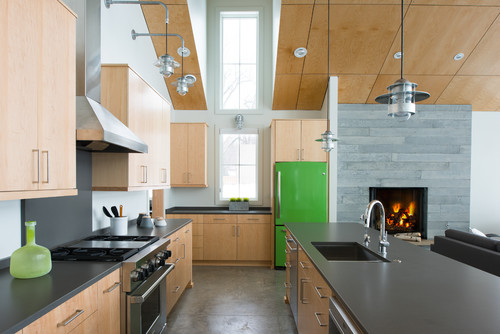
Stainless steel has been the industry standard for years, but the market is trending toward variety and fresh alternatives. Homeowners have more options available than ever to personalize their kitchens with vibrant colors, black stainless, or modern white appliances. Another favorite? Integrated appliances that blend seamlessly into cabinetry. Built-in column refrigerators, which allow you to customize the design and size of your freezer and refrigerator, are becoming a “must-have” in high-end homes.
Advancements in technology have also brought a new wave of appliances to the market. Induction cooktops are replacing commercial gas ranges as a gourmet favorite. And french door ovens and steam ovens are also gaining in popularity—especially ones with smart features you can control from an app on your smartphone.
5. COLORFUL KITCHENS
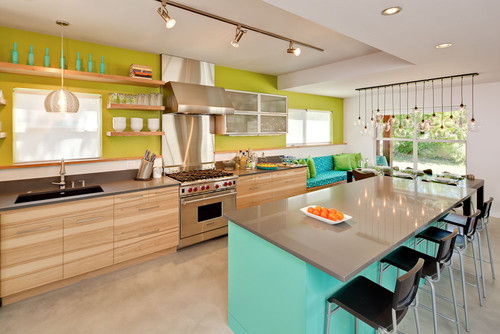
White will always be a classic choice, but color is finally coming back to kitchens. More homeowners are choosing cabinets in alternative neutrals like black, cream, and grey, along with colorful options like green and blue. Also popular? Wood cabinets in stains like warm chestnut and fruitwood.
Two-tone kitchen cabinets remain a homeowner favorite, as well. To incorporate this trend, try pairing darker lower cabinets with lighter upper cabinets or a colorful kitchen island with neutral-colored perimeter cabinets.
6. OPEN SHELVING
Swapping upper kitchen cabinets for open shelves continues to be a popular choice in 2019. It’s a cost-effective update that can make a kitchen feel larger and brighter. However, it’s not a practical option for everyone. Before you commit, test it out by removing your cabinet doors for a few weeks. See how it feels to have your glasses and dishware on display.
Not ready to give up all your upper cabinet storage space? Replace just one or two upper cabinets with open shelves for a lower-commitment but still-updated look.
7. STATEMENT TILE
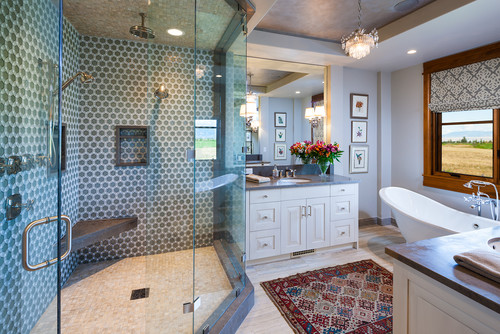
The ubiquitous white subway tile is finally fading in popularity. In 2019, homeowners are gravitating toward more colorful choices, creative textures and finishes, and alternative shapes. Especially hot right now: hexagons, arabesques, diamonds, and Moroccan fish scales.
Natural stone remains a favorite, including marble, quartzite and river rock. But advancements in porcelain tile that mimics stone, and even concrete, has made it an attractive, affordable, and low-maintenance alternative.
8. SHOWCASE CEILINGS
Once an afterthought, ceilings are taking center stage. While 2018 was all about statement walls, statement ceilings are shaping up to be the darling of 2019. Designers are using bold paint colors, wallpaper, intricate moldings, fabric, and other materials to transform a ceiling into something truly special.
Want to incorporate this trend without going too bold? Choose a classic design, like coffered or wooden beams. Or stick with wood paneling or tin tiles for a more timeless look. Even something as simple as painting a ceiling the same color as the walls can make your space feel more modern.
DESIGNED TO SELL
Are you contemplating a remodel? Want to find out how upgrades could impact the value of your home? Give us a call for a free consultation!
Buyer preferences can vary greatly by neighborhood and price range. We can share the insights we’ve gathered from working with buyers in this market … and offer tips on how to maximize the return on your remodeling investment. And if you’re in the market to sell, we can run a Comparative Market Analysis on your home to find out how it compares to others in the area.
Want to learn more about how to stage your home to sell? Contact us at john@coloradolifestyleproperties.com to request a free copy of our report: 10 Staging Secrets From the Pros for a Quick Sale at Top Dollar!
Sources:
- Decor Mag –
https://www.decoraid.com/blog/home-design-trends-2019
- Gates Interior Design –
https://gatesinteriordesign.com/hottest-new-kitchen-and-bath-trends-for-2019/
- House Beautiful –
https://www.housebeautiful.com/home-remodeling/interior-designers/a24844028/home-trends-for-2019/
- Houzz –
https://www.houzz.com/ideabooks/114552119/list/32-home-design-trends-that-will-rule-in-2019
- Invaluable –
https://www.invaluable.com/blog/mixing-metals/
- Real Simple –
https://www.realsimple.com/home-organizing/decorating/decorating-tips-techniques/design-trends-2019-according-to-designers
- Sebring –
https://sebringdesignbuild.com/top-trends-in-kitchen-design/
by John Farley | Oct 28, 2016
What is Home Equity?
Home equity seems to be a very simple calculation — the total amount of mortgages owed subtracted from the current market value of a home. Here is a simple example:
Current Home Market Value $325,000
Existing Mortgage $225,000
Homeowner Equity $100,000
One side of the equation is well defined, and it is found on the monthly mortgage statement, the loan balance. The other side is less obvious — the current market value of the property.
As a homeowner, your down payment purchases your initial equity, and your monthly (or additional) principal payments increase your equity. In strong real estate markets and in-demand locations, equity can increase quite rapidly as the property value increases, but the inverse can also happen — too much available inventory and market down-cycles can lead to falling home values and a reduction in homeowner equity.
It can be difficult to put an accurate value on something that you have emotional and monetary vesting in. It is safe to say that most people think their home is worth more than then it is.
Homeowners can make savvy assessments about their home’s current market value by following the sales of similar properties in the neighborhood, but should stay away from websites such as Zillow and Trulia, which provide inaccurate and outdated estimates. The most accurate measurement requires a comparative market analysis from a real estate professional or having the home professionally appraised. But, the bottom line — your home is worth as much as someone is willing to pay for it.
Creating Value is in Your Hands
Maintaining the condition of a home is vitally important to retaining and increasing value. Homes are judged against their peers: how they compare to similar homes in the neighborhood. Another way to retain value is to not over upgrade, since it is rare to ever recoup the money spent if you exceed neighborhood value. Keep up the landscaping and do the little things to add curb appeal.
Putting Home Equity to Work
Home equity represents the largest single asset of millions of people, and because it represents so much of an individual’s net worth, it must be treated with respect. Home equity is not a liquid asset until a property is sold, or it is borrowed against.
There are two types of loans that tap into homeowner equity as collateral.
Home Equity Loans
Many home equity plans set a fixed period during which the person can borrow money, such as 10 years. At the end of this “draw period,” the person may be allowed to renew the credit line. If the plan does not allow renewals, the homeowner will not be able to borrow additional money once the period has ended. Some plans may call for payment in full of any outstanding balance at the end of the period. Others may allow repayment over a fixed period, for example, of 10 years.
A home equity loan, sometimes called a second mortgage, usually has a fixed rate and a set time to pay it back, generally with equal monthly payments.
Home Equity Line of Credit
A home equity line of credit is similar to a credit card. The lender sets a maximum amount you can borrow, and you can draw money as you need it, though many home equity lines of credit require an initial draw. The interest rate varies daily, and is usually prime plus a set number, but the required payment is usually interest only. Once the loan has been paid down, the payment is reduced, and it can be paid off and initiated as many times as a homeowner requires.
How Much Equity can be Accessed?
Since the financial institution is lending money and using a home as collateral, they will not lend 100% of the home’s equity. The bank does not want to take the risk that if the house price drops, they would be carrying a loan for more than its market value. Therefore, most banks will allow a qualified homeowner to borrow approximately 80% of their equity.
It’s Important to Use Your Home Equity Wisely
Because it is likely the biggest asset most people have, losing your home equity is hard to overcome. It must be used in prudent ways, and the payments against the loan must be affordable. Using equity money to make the loan payment is only acceptable for a short-term solution.
There are number of good reasons to use money from a home equity loan… and some really bad ones. First, let’s cover smart uses.
1. Invest in Your Home
The best way to use the money is create more equity in the home. Among the very best returns on your investment (ROI) include kitchen and bathroom remodels, adding square footage or an extra bath, enhancing curb appeal and repairing/keeping the existing structure sound. Making prudent investments in your home is a wonderful win-win: you enjoy the upgrades and the repairs can add value to the home.
2. Invest in your Children’s Education
Using your home equity to finance a child’s higher education may be the greatest payoff of all. Not only is the rate much lower than a student loan, it is an investment in the child’s future.
3. Supplement Retirement Needs
Older homeowners spent their working lives paying down their mortgage. At retirement, when monthly income is reduced, a home equity loan could pay for a dream vacation or an unexpected major expense.
4. Augment the Impending Sale of a Home
If you’re planning to sell soon, a home equity line of credit may be the best way to finance improvements, and you can pay it off entirely when you sell. Investing wisely on upgrades and repairs may even reap a profit on your investment.
Here are some examples of some not very wise choices.
Adding luxury amenities like a swimming pool, a hot spa, lavish landscaping, expensive appliances and exotic countertops and flooring rarely pay off.
Purchasing a car or boat or most any personal luxury items is a poor use of the funds, since these items quickly depreciate in value.
Also stay away from using money on risk-heavy investments. Financing stock purchases, start-up businesses and paying routine bills is not financially smart. If you cannot afford to purchase those items with available funds, using equity from your home means they should not be in your budget.
You should treat a home equity loan as an investment and not as extra cash when making financial decisions. If your intended use of the money doesn’t pay you back in some way, it’s not the best use of your valuable equity.
We Are Happy to Assist You
If you would like an assessment of the market value of your home and the current equity you can access, give us a call at 303-475-6269 or email 2johnfarley@gmail.com for a comparative market analysis.
by Farley Webmaster | Apr 28, 2016

Whether you’re putting your home on the market this year or in the next five years, it is a smart decision to start building your home’s resale value now. Here are some ways to create a comfortable home while making it easier to put more money into your bank account on closing day.
Small Maintenance and Repairs
If you think that home maintenance on the weekends waste your time and energy, think again. The small chores you do around your home prevents it from losing value. Neglecting small maintenance and repairs causes 10% of your home’s value to walk out your door and slip through your windows. Most appraisers claim that homes showing little to no preventative maintenance can depreciate from $15,000 to $20,000.
A study conducted by researchers at the University of Connecticut and Syracuse University shows that regular maintenance boosts your home value by about 1% per year. However, ongoing maintenance costs offset that value, which means that regular maintenance actually slows down your rate of depreciation. Furthermore, because homebuyers generally notice any repairs needed upon buying a new home, proactive maintenance lets the homebuyer know that he or she will not have to spend extra money to maintain the basics. This makes your home more attractive, and thus more likely to get higher priced offers.
Maintaining the basics can cost you little money and certainly some effort, but there’s a way to accomplish this very important activity smartly. This article by HouseLogic, for example, shows you how to keep home maintenance below $300 a year. Planning ahead will also help make maintaining your home easier. Most professional appraisers and real estate agents recommend a proactive maintenance schedule that includes:
- Keeping enough cash on hand to replace systems and materials
- Creating and following a maintenance schedule
- Planning a room redo every year
- Keeping a notebook of all your maintenance and repairs
Landscaping
The Virginia Cooperative Extension at Virginia Tech published a study that shows landscaping can increase a home’s value by 15%. The study claims that a home valued at $150,000 could increase its value between $8,300 and $19,000 with the addition of landscaping. Particular landscape elements add different value. For instance, landscape design can increase your home’s value by 42%, plant size can increase your home’s value by 32%, and diversity in plants can increase your home’s value by 22%.
Replace Entrance Doors
If your entry doors are wood, consider switching them out for either fiberglass or steel doors. Steel doors add style and architectural interest to your home while improving security; you can add a deadbolt and electronic keypads to keep out intruders. Unlike wood doors, steel doors do not rot or splinter.
Alternatively, fiberglass doors can be designed to look like wood doors and give your home a modern look. Fiberglass doors conserve more energy than steel doors.
Pricewise, a steel door will cost you $1,335 with a 91% return on investment whereas a fiberglass door will cost you $3,126 with an 82.3% return on investment.
Garage Door Replacement
At first, you might not think that your garage door increases the value of your home. However, your garage door distinguishes your home from the other homes on your block. As the largest entryway of a house, garage doors get noticed first because they’re the focal point of your home. If you want to quickly increase the resale value of your home, you need to make the most of this space.
Some interesting things being done with garage doors include:
- Increased Size: Bigger garage doors help homes stand out more, and homeowners can do more creatively with them.
- Bold Colors: Bright and bold colors now can complement the color of your home, or you can build a concept around the color of your home.
- Faux Wood: You can install fiberglass or steel garage doors that look like wood garage doors. This gives your home a new level of sophistication.
- Windows: Large Windows on your garage door improve the aesthetic of your home, and provide light into your garage so that it’s no longer a dark space.
More importantly, a garage door replacement will cost you $1,652 and add $1,512 to the value of your home; that’s a return on your investment of 91.5%.
Fiberglass Attic Insulation
While energy efficiency is still not the sexiest selling point of your home, installing fiberglass attic insulation saves energy and garners a big payback on your investment. According to Remodeling Magazine’s 2016 Cost vs. Value top trends report, fiberglass attic insulation gained the top return on investment among the 30 projects in this year’s report. Using Remodel/Max as the cost source, a fiberglass attic insulation project cost $1,268 nationwide. Real estate professionals surveyed estimated that the work would boost the price of a home at resale, within a year of its completion, by $1,482. That’s a 116.9% return on investment.
Replacing Windows
Replacing your windows is another way to save energy and increase your home’s resale value. Replacing your old windows with energy saving models will beautify your home, keep it comfortable, and ease the workload of your HVAC system. According to HGTV, you’ll see a reduction in your utility bill by 7% to 15%. However, if you’re selling your home, you could expect a 60% to 70% recoupment of your investment. The two types of replacement windows that fetch the best return are vinyl and wood.
Remodeling Your Kitchen
Kitchen remodeling can get expensive, but small renovations can make your home more buyer friendly. Changing your kitchen’s texture and color using a matte finish and neutral colors such as putty or grey enhances your home’s resale value. Because matte finishes have transitional qualities, your potential homebuyer can easily match his or her stainless steel or black and white appliances. Also, refinishing cabinetry, or switching to Energy Star™ appliances provide comfort you like and pizazz buyers adore.
Flow is important to any interior design of a home. If you feel that your kitchen hinders a good flow, change it. A small investment to knock out a non-structural wall or remove a kitchen island creates space and provides flow that buyers love.
A minor kitchen remodel can cost you $20,122 while putting $16,716 of resale value into your home; that’s an 83% payback on the project. If you want to do a major kitchen model, this can cost you about $60,000 and put about $39,000 of resale value into your home, which is only about a 65% payback on the project. Therefore, consider a minor kitchen remodel first.
Bathroom Addition or Remodel
Likewise, carefully consider adding a bathroom or remodeling your bathroom. Switching out your frosted glass shower doors for glass doors, cleaning the grout, replacing the shower and floor tiles, switching out your sink or toilet, or replacing your sink and shower fixtures can cost you little money.
Adding a bathroom can get expensive, but it can reduce congestion during hectic times and provide your guests with a bathroom. Consult with your real estate agent or a local appraiser before deciding whether a full remodel or addition is right for your situation. While a bathroom remodel will cost you about $18,000 with a return on investment of about 66%, a bathroom addition will cost you about $42,000 with a return on investment of about 56%. Therefore, it’s best do your due diligence before working on your bathroom.
Your Needs and Buyers’ Wants
On that note, if you need to renovate your home, be sure to consider how those changes will affect its appeal to future buyers. Knowing design trends will give you the opportunity to make changes to your home based on where your needs and your potential buyer’s desires intersect, thus increasing your property’s resale value drastically.
Designers and design websites provide great ideas when you’re brainstorming home renovations. Keep in mind as you research, however, that you don’t want to sacrifice your needs for a comfortable home just for the sake of what you think a future buyer will want!
Therefore, before you begin making any changes to your home, consult your real estate agent. Real estate agents, because we are constantly working with new buyer clients, have insider insight into what home buyers are looking for now and in the future. We’ll be able to help you make smart choices when remodeling or renovating your home.
If you think you might want to remodel or renovate your home in the near future, or if you are just curious about other ways you can increase its resale value, please reach out to me!