by Farley Webmaster | Jun 13, 2018

Whatever your reasons are for relocating to a new area, the process can feel overwhelming.
Whether you’re moving across across town or across the country, you’ll be changing more than your address. Besides a new house, you may also be searching for new jobs, schools, doctors, restaurants, stores, service providers and more.
Of course you’ll need to pack, make moving arrangements, and possibly sell your old home. With so much to do, you may be wondering: Where do I start?
In this guide, we outline seven steps to help you get prepared, get organized, and get settled in your new community. Our hope is to alleviate the hassle of relocating—so you can focus on the exciting adventure ahead!
1. Gather Information
If you’re unfamiliar with your new area, start by doing some research.1 Look for data on average housing prices, demographics, school rankings and crime statistics. Search for maps that illustrate local geography, landmarks, public transportation routes and major interstates. If you’re moving across the country, research climate and seasonal weather patterns.
Check out local newspapers and blogs for information on political issues and developments that could impact your new community. You may also want to search for online forums and Facebook Groups relevant to your new area. These can be a great place to find information, ask questions and just observe local attitudes and outlooks.
If you’re relocating for a job, find out if your new employer offers any relocation assistance. Many large corporations have a designated human resources professional to assist employees with relocation efforts, while others may contract this service out to a third party. Some employers will also cover all or a portion of your relocation and moving costs.
By gathering this information up front, you’ll be better prepared to make informed decisions down the road.
| Let us know if you’d like assistance with your information gathering process. We have a wealth of knowledge about this area, and we keep a number of reports and statistics on file. We would be happy to share information and answer any questions you may have. |
2. Identify Your Ideal Neighborhoods
Once you’ve sufficiently researched your new area, you can start to identify your ideal neighborhoods.
The first step is to prioritize your “needs” and “wants.” Consider factors such as budget; commute time; quality of schools; crime rate; walkability; access to public transportation; proximity to restaurants, shopping, and place of worship; and neighborhood vibe.
If possible, visit the area in person to get a feel for the community. If you’re comfortable, strike up conversations with local residents and ask about their experiences living in the area.
Still not sure which neighborhood is the best fit for you and your family? Contact a local real estate agent for expert assistance. It’s usually the most efficient and effective way to narrow down your options.
| We provide neighborhood assessments and advice as a free service if you’re relocating to Boulder, Colorado or near by areas. Or, if you’re moving out of town, we can refer you to a local agent who can help. |

Charming Bungalow 1/2 Mile to Pearl Street 646 Marine Street, Boulder, 80302
3. Find Your New Home (and Sell Your Old One)
Once you’ve narrowed down your list of preferred neighborhoods, it’s time to start looking for a home. If you haven’t already contacted a real estate agent, now is the time. They can search for current property listings that meet your needs, typically at no cost to you.
Create another list of “needs” and “wants,” but this time for your new home. Include your basic requirements for square footage, bedrooms and bathrooms, but also think about what other factors are important to you and your family. An updated kitchen? A large backyard? Double sinks in the master bathroom?
Narrow your list down to your top 10 and prioritize them in order of importance.2 This will give you a good starting point to begin your home search. Unless you have an unlimited budget, don’t expect to find a home with everything on your list. But having a prioritized list can help you (and your agent) understand which home features are the most important, and which ones you may be willing to sacrifice.
If you already own a home, you’ll also need to start the process of selling it or renting it out. A real estate agent can help you evaluate your options based on current market conditions. He or she can also give you an idea of how much equity you have in your current home so you know how much you can afford to spend on your new one.
Your agent can also advise you on how to time your sale and purchase. While some buyers are able to qualify for and cover the costs of two concurrent mortgages, many are not. There are a number of options available, and a skilled agent can help you determine the best course given your circumstances.
| We would love to assist you if you have plans to buy or sell a home in Boulder, Colorado. Please contact us to schedule a free consultation so we can discuss your unique needs and devise a custom plan to make your relocation as seamless as possible. If you’re relocating outside of Colorado, we can help you find a trusted agent in your new city. |
4. Prepare for Your Departure
While everyone considers packing a fundamental part of moving, we often overlook the emotional preparation that needs to take place. If you have children, this can be especially important. Communicate the move in an age-appropriate way, and if possible take them on a tour of your new home and neighborhood. This can alleviate some of the mystery and apprehension around the move.4
Allow yourself plenty of time to pack up your belongings. Before you start, gather supplies, including boxes, tape, tissue paper and bubble wrap. Begin with non-essentials—such as off-season clothes or holiday decorations—and sort items into four categories: take, trash, sell and donate/give away.5
To make the unpacking process easier, be sure to label the top and sides of boxes with helpful information, including contents, room, and any special instructions. Keep a master inventory list so you can refer back to it if something goes missing.
If you will be using a moving company, start researching and pricing your options. To ensure an accurate estimate of your final cost, it’s best to have them conduct an in-person walkthrough. Make sure you’re working with a reputable company, and avoid paying a large deposit before your belongings are delivered.6
If you plan to drive to your new home, map out the route. And, if necessary, make arrangements for overnight accommodations along the way. If driving is not a good option, you may need to have your vehicles transported and make travel arrangements for you, your family and your pets.
Lastly, if you will be leaving friends or family behind, schedule final get-togethers before your departure. The last days before moving can be incredibly hectic, so make sure you block off some time in advance for proper goodbyes.
| Looking for a reputable moving company? We are happy to provide referrals, as well as recommendations on where to procure packing supplies in our area. |

Learn more about the neighborhoods that make up Boulder, Colorado
5. Prepare for Your Arrival
To make your transition go smoothly, prepare for your arrival well before moving day. Depending on how long your belongings will take to arrive, you may need to arrange for temporary hotel accommodations. If you plan to move in directly, pack an “essentials box” with everything you’ll need for the first couple of nights in your new home, such as toiletries, toilet paper, towels, linens, pajamas, cell phone chargers, snacks, pet food and a change of clothes.7 This will keep you from searching through boxes after an exhausting day of moving.
Arrange in advance for your utilities to be turned on, especially essentials like water, electricity and gas. (And while you’re at it, schedule a shut-off date for your current utilities.) Update your address on all accounts and subscriptions and arrange to have your mail forwarded through the postal service. If you have children, register them for their new school or daycare and arrange for the transfer of any necessary records.
You may want to have the house professionally cleaned before moving in. And if you plan to remodel, paint or install new flooring, it’s easier to have it done before you bring in all of your belongings.8 However, it’s not always feasible without someone you trust locally who can supervise. Another option is to keep a portion of your things in storage while you complete some of these projects.
If there are no window treatments, you may need to install some (or at least put up temporary privacy film), especially in bedrooms and bathrooms. And if appliances are missing, consider purchasing them ahead of time and arranging for delivery and installation shortly after you arrive. Just be sure to check measurements and installation instructions carefully so you aren’t stuck with an appliance that doesn’t fit or that requires costly modifications to your new home.
If you own a car, check the requirements for a driver’s license and vehicle registration in your new area and contact your insurance company to update your policy.8 If you will rely on public transportation, research options and schedules.
| If you’re relocating to Boulder, we can help! We offer “VIP Relocation Assistance” to all of our buyer clients. Contact us for a list of preferred hotels, utility providers, housekeepers, contractors and more! |
6. Get Settled In Your New Home
While staring at an endless pile of boxes can feel daunting, you should take advantage of this opportunity to make a fresh start. By creating a plan ahead of time, you can ensure your new house is thoughtfully laid out and well organized.
If you followed our suggestion to pack an “essentials box” (see Step 5), you should have easy access to everything you’ll need to get you through the first couple of nights in your new home. This will allow you some breathing room to unpack your remaining items in a deliberate manner, instead of rushing through the process.7
If you have young children, consider unpacking their rooms first. Seeing their familiar items can help them establish a sense of comfort and normalcy during a confusing time. Then move on to any items you use on a daily basis.10
Pets can also get overwhelmed by a new, unfamiliar space. Let them adjust to a single room first, which should include their favorite toys, treats, food and water bowl, and a litter box for cats. Once they seem comfortable, you can gradually introduce them to other rooms in the home.11
As you unpack, make a list of items that need to be purchased so you’re not making multiple trips to the store. Also, start a list of needed repairs and installations. If you have a home warranty, find out what’s covered and the process for filing a service order.
Although you may be eager to get everything unpacked, it’s important to take occasional breaks. Have some fun, relax and explore your new hometown!
| Need help with unpacking, organizing or decorating your new home? Contact us for a list of recommended professionals in Boulder. And when you’re ready to start exploring local “hot spots,” we’d love to fill you in on our favorite restaurants, stores, parks and other attractions! |

Get an insider’s guide to Boulder
7. Get Involved In Your New Community
Studies show that moving can lead to feelings of loneliness and depression. People who have recently moved tend to be isolated socially, more stressed, and less likely to participate in exercise and hobbies. However, there are ways to combat these negative effects.12
First, get out and explore. In a 2016 study, recent movers were shown to spend less time on physical activities and more time on their computers, which has been proven to lead to feelings of depression and loneliness. Instead, get out of your house and investigate your new area. And if you travel by foot, you’ll gain the advantages of fresh air and exercise.12
Combat feelings of isolation by making an effort to meet people in your new community. Find a local interest group, take a class, join a place of worship or volunteer for a cause. Don’t wait for friends to come knocking on your door. Instead, go out and find them.
Finally, be a good neighbor. Make an effort to introduce yourself to your new neighbors, invite them over for coffee or dinner, and offer assistance when they need it. Once you’ve developed friendships and a support system within your new neighborhood, it will truly start to feel like home.
| Want more ideas on how to get involved in your community? Contact us for a free copy of our report, “Welcome Home: 10 Tips to Turn Your Neighborhood Into a Hometown Haven.” |
LET’S GET MOVING
While moving is never easy, these seven steps offer an action plan to get you started on your new adventure. To avoid getting overwhelmed, focus on one step at a time. And don’t hesitate to ask for help!
In a 2015 study, 61 percent of participants ranked moving at the top of their stress list, above divorce and starting a new job.13 But with a little preparation—and the right team of professionals to assist you—it is possible to have a positive relocation experience.
We specialize in assisting home buyers and sellers with a seamless and “less-stress” relocation. Along with our referral network of movers, handymen, housekeepers, decorators, contractors and other service providers, we can help take the hassle and headache out of your upcoming move. Give us a call or message us to schedule a free, no-obligation consultation!
_______________________________________________________________________________
Sources:
- You Move Me –
https://www.youmoveme.com/us/blog/105-tips-for-a-successful-relocation
- com –
https://www.houselogic.com/buy/house-hunting/must-have-items/
- Livestrong –
https://www.livestrong.com/article/436651-the-effects-of-sunlight-fresh-air-on-the-body/
- Parents Magazine –
https://www.parents.com/parenting/money/buy-a-house/make-moving-easier-on-you-and-your-kids/
- The Spruce –
https://www.thespruce.com/starting-to-pack-for-your-move-2436470
- com –
https://www.moving.com/tips/hiring-quality-movers/
- The Spruce –
https://www.thespruce.com/unpack-your-entire-home-2435815
- com –
https://www.houselogic.com/buy/moving-in/before-you-move/
- HGTV –
https://www.hgtv.com/design/real-estate/moving-checklist
- com –
https://www.moving.com/tips/how-to-unpack-and-organize-your-house/
- ASPCA –
https://www.aspca.org/pet-care/general-pet-care/moving-your-pet
- Psychology Today –
https://www.psychologytoday.com/us/blog/is-where-you-belong/201607/why-youre-miserable-after-move
- The Daily Express –
https://www.express.co.uk/news/uk/574171/Divorce-stressful-moving-home
SaveSave
SaveSave
by Farley Webmaster | May 8, 2018
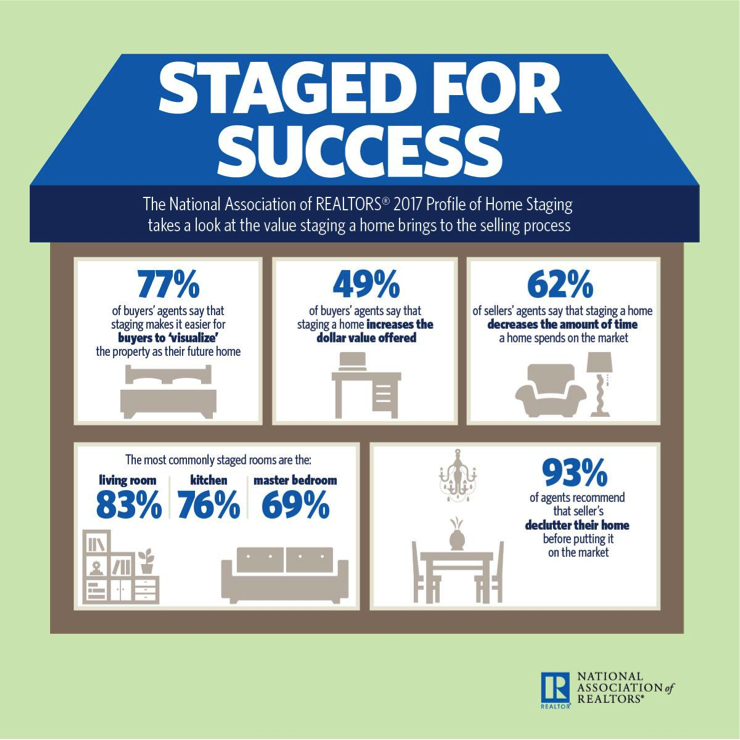
According to the National Association of Realtors, staging a home prior to listing it can result in a faster and more profitable sale.1 In fact, the Real Estate Staging Association estimates that professionally staged properties spend 73 percent less time on the market, receive more foot traffic, and typically sell for more money.2
Following are 10 tips you can use to get your home “show ready” prior to hitting the market. These easy and cost-effective ideas will help your house look its best—and help buyers visualize themselves living there. Even if you’re not currently in the market to sell, you can use these tactics to breathe new life into your existing home decor.
To get a plan customized for your particular property, give us a call to schedule a free consultation. We’d be happy to share our insider knowledge of the buyer preferences in your neighborhood … so you’ll know where to focus your time, money and energy to maximize your results.
1. REMOVE CLUTTER
Decluttering is typically the first thing we tell clients to do to prepare their home for sale. And according to the National Association of Realtors, a whopping 93 percent of agents agree.1Decluttering is the act of removing excess “stuff” from your home to make it appear clean and spacious.
Overflowing closets and cluttered countertops can make your house feel small and cramped. In contrast, sparsely-filled closets and clear countertops will make your home appear larger and assure buyers that there will be plenty of room to store their belongings.
Don’t neglect drawers, cupboards and even your refrigerator in your decluttering efforts. Serious buyers will check out every nook and cranny of your home, so pack up anything you don’t use on a daily basis and store it off site. The same goes for jewelry, sensitive documents, prescription medication, firearms and other items of value. Store them in a locked safe or storage unit before opening your property to buyers.
Make sure any items that remain are clean, tidy and well organized. The good news is, when it comes time to move, a large portion of your packing will be done!

2. DEEP CLEAN AND DEODORIZE
From carpets to bathrooms to appliances, having a clean home is a MUST. If you’ve ever checked into a dirty hotel room, you can imagine how buyers can be turned off by a home that hasn’t been thoroughly cleaned.
If you have a large home, or are short on time, you may want to invest in a professional cleaning service. And if you have carpet, we generally recommend you rent a steam cleaner or hire a company to clean your carpets for you.
In addition to cleaning, it’s equally important to neutralize odors in your home that can be off-putting to buyers, especially pet smells and cigarette smoke. If the weather allows, open your windows and let in fresh air. Empty the trash frequently, and especially before a showing. Avoid cooking any strong-smelling food such as fish or heavy spices. You may need to clean (or remove) drapes and upholstery if odors are particularly strong.
Try to keep your home in clean, show-ready condition while it’s on the market. You never know when a potential buyer will want to drop by for a viewing.
3. DEPERSONALIZE
Your family photos and personal mementos are often your most treasured possessions. For many of us, they are what make a house a home. However, buyers will have a hard time envisioning themselves living in a place if it feels like YOUR home.
Pack up any items that are personal to you and your family, such as photos, books, children’s artwork, travel souvenirs and religious items. Collectibles and excessive knickknacks can be distracting to buyers. Instead, keep your decor items minimal and generic to appeal to the largest number of buyers.
4. NEUTRALIZE YOUR COLOR PALETTE
Along those same lines, bold color choices may not appeal to all buyers. By incorporating a neutral color palette throughout your home, buyers can better visualize the addition of their own furniture and decor, which may contrast with your current color scheme.
But don’t limit yourself to white and beige. Incorporating earth tones and midtone neutrals—like mocha and “greige” (grey-beige)—can add a touch of modern sophistication to your decor.3
One of the quickest and most cost-effective ways to neutralize your home’s decor is with paint. Walls painted in dark, bold or bright colors can turn off buyers. A fresh coat of paint in a neutral color like greige (try Benjamin Moore’s Revere Pewter) or warm white (such as Kelly-Moore’s Rotunda White) offers a clean palette upon which buyers can visualize adding their own personal touches.4
If your sofa is worn, stained or has a bold pattern, consider purchasing a neutral-colored slipcover. Dated or overly busy window coverings should be taken down or replaced. Instead, bring in tasteful pops of color with throw pillows and accessories.
5. INCREASE YOUR CURB APPEAL
You only get one chance to make a first impression. According to a 2017 report by the National Association of Realtors, 44 percent of home buyers drove by a property after viewing it online but did NOT go inside for a walkthrough.5That means if your curb appeal is lacking, buyers may never make it through the door.
Walk around your home and look for any neglected areas that might seem like “red flags” to buyers, such as missing roof shingles or rotted siding. Trim trees and shrubs if needed, and make sure your lawn and flower beds are well maintained. Add some colorful flowers to your front beds and/or flower boxes to brighten up your landscaping.
Make sure the exterior of your home is as clean as the interior. This can often be accomplished with a simple garden hose. But if your siding, walkway, or driveway are stained or dingy, you may want to rent a pressure washer.
Thoroughly wash windows and screens, and remove and store dark solar screens if you have them. Open shutters, curtains and blinds, which will not only make your house look more inviting from the outside, it will brighten the inside.
Consider a fresh coat of paint on your front door, trim and shutters. And small, cosmetic improvements like new house numbers, a colorful wreath and a clean front doormat can have a big impact.6
6. FRESHEN KITCHENS AND BATHS
Kitchens and bathrooms will show better and appear larger if all items are cleared from the countertops, except for one or two decorative pieces.7You should have already packed up non-essentials during your decluttering process, and the remaining items should be neatly stored in pantries and cupboards.
If your cabinets are dingy or outdated, adding a fresh coat of paint and new hardware is an easy and inexpensive way to make them modern and bright. Consider purchasing new shower curtains, bath mats and towels for the bathrooms and new dish towels for the kitchen.
Before each showing, make sure kitchens and baths are spotless and trash cans are empty and out of sight. To add a comforting aroma, try baking cookies, or in the fall, simmer some cinnamon sticks and cloves in a pot of water before you leave the house. In the spring, try a vase of fresh cut lilacs.7
7. SET THE TABLE
Buyers often imagine hosting family gatherings in their new home, and the dining room plays a large role in that vision. If your dining room chairs are stained or outdated, you may want to recover them or use slipcovers. In most cases, an imperfect table can be camouflaged with a neutral and stylish tablecloth.
Be sure the table is centered underneath the chandelier and on the area rug if you’re using one. If your dining room is small, remove all other furniture and leave only four chairs.8
Dress up the table using nice tableware and cloth napkins or a table runner and centerpiece. For a long table, try lining up a series of small vessels down the middle.
8. REARRANGE FURNITURE
Start in your living room and think about what you want to emphasize (and de-emphasize) about the space. For example, do you have a beautiful fireplace or a stunning view? If so, arrange the furniture with that focal point in mind. Use a symmetrical seating arrangement to create a cozy conversation area adjacent to the focal point.
If the room is small, consider removing some of the furniture to make it feel larger, especially oversized pieces. That includes oversized television sets, unless it’s a designated media room. Pulling furniture away from the wall can make the room feel more spacious, and placing your largest furniture piece in the far-left corner (as opposed to near the entry) can create the illusion of a larger space.9
For small bedrooms, remove all the furniture except the bed, bedside tables and a dresser. If it’s a large room, add one or two chairs and a table to create a seating area. Place lamps on the bedside tables and seating area if you have one.10
Make sure each space in your home has a clearly defined purpose. For example, if you’ve been using an extra bedroom as a catch-all storage space, stage it as a guest room or office instead. Turn an awkward alcove into a workstation or a reading corner. Help buyers imagine how they could use the space themselves.3
9. LIGHTEN UP
Lighting can have a drastic impact on the look and feel of a home. Few buyers seek out a dark house; most prefer one that’s light and bright. Make sure windows are clean, and open curtains and blinds to let in the maximum amount of daylight.
Each room should have three types of lighting: ambient (general or overhead), task (such as a reading lamp or under-cabinet light), and accent (such as a floor or table lamp). Aim for a goal of 100 total watts per 50 square feet.11If your mounted light fixtures are dated, replacing them with something more modern is an easy and inexpensive upgrade that can have a big impact.
Strategically placed landscape lighting can add a dramatic effect to your home’s exterior. Welcome evening visitors with a lighted walkway, or use a spotlight to accentuate trees or other landscaping features. Solar lights require no wiring; simply place them in a sunny spot and they will turn on automatically at dusk.
10. HIGHLIGHT YOUR BACKYARD’S BEST FEATURES
While your home’s interior often takes center stage, don’t forget about staging your home’s outdoor areas to help buyers imagine how they could utilize the space.
Even a small patio can become a selling feature with the addition of a cafe table and chairs. Add a tray of plates and coffee cups to help buyers envision a peaceful breakfast on the back porch. Place chairs and wine glasses around an outdoor firepit or hang a hammock with a book in your favorite shady spot.3 These small, simple additions can help buyers visualize the possibilities your backyard has to offer.
BEFORE YOU GET STARTED
If you’re in the market to sell your home, this list provides a great starting point for your preparations. But nothing beats the trained eye and expertise of a real estate agent. Before you do any work, we recommend consulting a professional for advice about your particular property.
We offer free, no-commitment seller consultations and will walk through your home with you to help you assess which projects and upgrades are worth your time and money, and which ones you can skip.
As Boulder market experts, we are intimately familiar with buyer preferences in our area . We’ll run a comparative market analysis to find out how your home compares to others currently on the market, as well as those that have recently sold. Then we’ll tailor a custom plan to suit your particular property, budget and needs. Even in a hot market like Boulder or the Denver Metro area, details are important to ensure you sell your home quickly and for the best price.
Please call us today at 303-475-6269 with questions or to schedule a free consultation!
SaveSaveSaveSave
______________________________________________
Sources:
- National Association of Realtors –
https://www.nar.realtor/sites/default/files/migration_files/reports/2017/2017-profile-of-home-staging-07-06-2017.pdf
- Real Estate Staging Association –
http://www.realestatestagingassociation.com/content.aspx?page_id=22&club_id=304550&module_id=164548
- Houzz –
https://www.houzz.com/ideabooks/2661221/list/sell-your-home-fast-21-staging-tips
- HGTV –
https://www.hgtv.com/design/outdoor-design/landscaping-and-hardscaping/10-curb-appeal-tips-from-the-pros-pictures
- National Association of Realtors –
https://www.nar.realtor/sites/default/files/reports/2017/2017-home-buyer-and-seller-generational-trends-03-07-2017.pdf
- The Spruce –
https://www.thespruce.com/must-try-neutral-paint-colors-797983
- HouseLogic –
https://www.houselogic.com/sell/preparing-your-home-to-sell/home-staging-checklist/
- com –
http://www.stagemyownhome.com/staging-the-dining-room.html
- com –
https://www.realtor.com/advice/sell/small-living-room-staging-tricks/
- SFGATE –
http://homeguides.sfgate.com/stage-master-bedroom-34573.html
- HGTV –
https://www.hgtv.com/shows/designed-to-sell/15-secrets-of-home-staging-pictures
SaveSave
SaveSave
SaveSave
by Farley Webmaster | Jan 10, 2018
As we head into a new year, the most common question we receive is, “What’s the outlook for real estate in 2018?”
It’s not just potential buyers and sellers who are curious; homeowners also want reassurance their home’s value is going up. The good news is that a strong U.S. economy, coupled with low unemployment rates, is expected to drive continued real estate growth in 2018. However, changes on the horizon could significantly impact you if you plan to buy, sell or refinance this year.
HOME VALUES WILL CONTINUE TO RISE
Get ready for another strong year! U.S. home values and sales volume will continue to rise in 2018.
Experts agree that home prices will increase in 2018, but predict a slower rate of appreciation than 2017, which clocked in at nearly 7 percent nationwide. National Association of Realtors (NAR) Chief Economist Lawrence Yun predicts a growth rate this year of 5.5 percent,1 while Freddie Mac’s September Outlook Report forecasts a rate of 4.9 percent. Either way, all indicators point towards continued growth in 2018.2
What does it mean for you? If you’re a current homeowner, congratulations! Real estate proves once again to be a solid investment over the long term. And if you’re considering selling this year, there’s never been a better time. Contact us to request a free Comparative Market Analysis to find out how much you can expect your home to sell for under current market conditions.
If you’re in the market to buy this year, there’s good news for you, too. Although prices continue to rise, the rate of appreciation has slowed. Still, don’t wait any longer. Prices will continue to go up, so you’ll pay more six months from now than you would today. Call us to setup a free, no-obligation property search and get notified about listings that meet your criteria as soon as (or before) they hit the market.
NEW CONSTRUCTION WILL MAKE REAL ESTATE MORE ACCESSIBLE
Lack of inventory in the housing market has been a primary impediment to homeownership for many Americans. “Ten years ago, the problem in the housing market was lack of buyers,” says Yun. “Today, the problem is lack of sellers. Inventory levels are near historic lows.”3
Yun also notes, “The lack of inventory has pushed up home prices by 48 percent from the low point in 2011, while wage growth over the same period has been only 15 percent. Despite improving confidence [in 2017] from renters that now is a good time to buy a home, the inability for them to do so is causing them to miss out on the significant wealth gains that homeowners have benefitted from through rising home values.”1
The good news? Yun expects a 9.4 percentage point increase in single-family new home construction starts.4
Economists at Freddie Mac make a similar prediction. “Existing home sales are unlikely to increase much going forward. Limited inventory will remain a consistent problem … Growth in home sales will be primarily driven by new home sales, which should continue to grind higher with single-family construction.”2
Robert Dietz, chief economist at the National Association of Home Builders, agrees. “The markets that are going to grow are ones where builders can add that entry level product.”5
What does it mean for you? If you’ve been frustrated by lack of inventory in the past, 2018 may bring new opportunities for you to find a budget-friendly home that suits your needs. Give us a call to discuss options for new construction in our area.
MILLENNIALS WILL MOVE TO THE SUBURBS
The new entry-level construction will come with a catch though … it will be located in the suburbs, where the availability of land and fewer zoning requirements make it more cost-effective to build. Economists predict that’s where millennials and first-time buyers will flock for the greater variety of homes at affordable prices.6
Rising home prices, a sluggish job market, and an increase in student loan debt made homeownership largely unattainable for many millennials in past years. However, there’s significant evidence that this trend is turning around. For the fourth year a row, the National Association of Realtors’ 2017 Home Buyer and Seller Generational Trends survey found that millennials were the largest group of homebuyers.7
As millennials age, they are settling down and having families, which has prompted an increasing demand for larger but affordable homes. Thus, many are flocking to the suburbs, with 57 percent of millennial buyers opting for a suburban location.
What does it mean for you? If you’re a millennial who has been priced out of urban living, or is looking for more space for your growing family, a number of suburbs in our area have a lot to offer. We can point you towards the communities that will best meet your needs.
And if you’re a suburban homeowner with plans to sell, give us a call. We know how to market your home to millennials … and can help you sell quickly for top dollar by appealing to this growing market segment!
BOOMERANG BUYERS WILL RETURN TO THE MARKET
“Boomerang buyers” comprise the nearly 10 million Americans who lost their homes to foreclosure or short sales during the housing recession of 2006 to 2014.
According to MyFico.com, a foreclosure remains on a credit report for seven years. It takes many boomerang buyers at least that long to raise their credit score and save up enough cash to qualify for a new mortgage.8
With this “seven-year window” in mind, RealtyTrac predicts that the largest wave of boomerang buyers – more than 1.3 million – will be eligible to re-enter the housing market in 2018.9
Markets likely to see the highest influx of boomerang buyers are those that had a high percentage of foreclosures AND have remained affordable. The majority of boomerang buyers are middle-class Gen Xers or Baby Boomers. Expect to see even more competition for entry-level homes in those markets.
What does it mean for you? If you’re a boomerang buyer, we understand your unique circumstances. We can help you navigate the real estate process and write competitive offers that will play to your strengths. Contact us to discuss your options.
NEW TAX LEGISLATION WILL IMPACT HOMEOWNER DEDUCTIONS
The “Tax Cuts and Jobs Act” passed at the end of 2017 nearly doubles the standard deduction, so far fewer Americans are expected to itemize this year. For those who do, however, it could mean less homeowner deductions are available than in the past.
Previously, homeowners could deduct interest paid on the first $1 million of mortgage debt, but that threshold has been lowered to $750,000 for new mortgages. (Existing mortgages will not be impacted.)
Additionally, taxpayers will no longer be able to fully deduct state and local property taxes plus income or sales taxes. The new legislation restricts this deduction to $10,000. It also eliminates the deduction for moving expenses (except for members of the Armed Forces) and interest on home equity loans unless the proceeds are used to substantially improve the residence.10
It’s yet to be seen how the tax bill will impact the real estate market overall. While some economists predict a price reduction in certain markets, Republican lawmakers project the bill will increase take-home pay and stimulate the economy overall. According to Realtor.com Senior Economist Joseph Kirchner, “Some house hunters—particularly wealthy buyers—will see an increase in after-tax income, making an already tough housing market even more competitive. This increased demand could drive prices up even higher than they are already.”11
What does it mean for you? If you’re an existing homeowner, be sure to consult a tax professional if you’re concerned about the impact the new tax bill could have on you.
And if you’re planning to buy or sell this year, we can help you determine how the tax bill could affect demand in your current or target neighborhood and price range.
INTEREST RATES WILL RISE
No one knows exactly what will happen with mortgage rates this year, but the Mortgage Bankers Association anticipates the Federal Reserve will raise rates three times in 2018, with Freddie Mac’s 30-year fixed rate mortgage reaching 4.8 percent by the end of Q4, up from around 4 percent at the end of 2017.12
Kiplinger.com Economist David Payne also predicts interests rates will rise this year, with short-term rates outpacing long-term rates as the Fed aims to curb inflation in a tightening job market. He predicts the bank prime rate that home equity loans are based on will increase from 4.25 percent to 5 percent by the end of 2018. 13
What does it mean for you? If you’re in the market to buy, act now. Rising interest rates will decrease your purchasing power, so act quickly before interest rates go up. Give us a call today to get your home search started.
And if you’re a current homeowner who is considering refinancing or a home equity loan, don’t wait. We can help you estimate your property’s fair market value so you’ll be prepared before contacting a lender.
2018 ACTION PLAN
If you plan to BUY this year:1. Get pre-approved for a mortgage. If you plan to finance part of your home purchase, getting pre-approved for a mortgage will give you a jump-start on the paperwork and provide an advantage over other buyers in a competitive market. The added bonus: you will find out how much you can afford to borrow and budget accordingly.
2. Create your wish list. How many bedrooms and bathrooms do you need? How far are you willing to commute to work? What’s most important to you in a home? We can set up a customized search that meets your criteria to help you find the perfect home for you.
3. Come to our office. The buying process can be tricky. We’d love to guide you through it. We can help you find a home that fits your needs and budget, all at no cost to you. Give us a call at 303.475.6269 to schedule an appointment today!
If you plan to SELL this year:
1. Call us for a FREE Comparative Market Analysis. A CMA not only gives you the current market value of your home, it’ll also show how your home compares to others in the area. This will help us determine which repairs and upgrades may be required to get top dollar for your property … and it will help us price your home correctly once you’re ready to list.
2. Prep your home for the market. Most buyers want a home they can move into right away, without having to make extensive repairs and upgrades. We can help you determine which ones are worth the time and expense to deliver maximum results.
3. Start decluttering. Help your buyers see themselves in your home by packing up personal items and things you don’t use regularly and storing them in an attic or storage locker. This will make your home appear larger, make it easier to stage … and get you one step closer to moving when the time comes! |
WE’RE HERE TO HELP
While national real estate numbers and predictions can provide a “big-picture” outlook for the year, real estate is local. And as local market experts, we can guide you through the ins and outs of our market, and the local issues that are likely to drive home values in your particular neighborhood. If you have specific questions, or would like more information about where we see real estate headed in our area, please give us a call at 303.475.6269 ! We’d love to discuss how issues here at home are likely to impact your desire to buy or a sell a home this year.
Sources:
- Inman News –
https://www.inman.com/2017/11/03/what-to-expect-from-the-2018-housing-market/
- Freddie Mac September Outlook Report –
http://www.freddiemac.com/research/outlook/20170921_looking_ahead_to_2018.html
- org –
https://www.marketplace.org/2017/07/05/economy/tight-inventory-slows-housing-market-down-0
- National Association of Realtors Press Release –
https://www.prnewswire.com/news-releases/existing-home-sales-to-grow-37-percent-in-2018-but-inventory-shortages-and-tax-reform-effects-loom-300549447.html
- Fox Business News –
http://www.foxbusiness.com/features/2017/11/27/entry-level-buyers-drive-solid-new-home-sales.html
- Zillow Research –
https://www.zillow.com/research/2018-predictions-17217/
- National Association of Realtors’ Home Buyer and Seller Generational Trends Report –
https://www.nar.realtor/research-and-statistics/research-reports/home-buyer-and-seller-generational-trends
- com –
https://www.myfico.com/crediteducation/questions/foreclosure-fico-score-affect.aspx
- RealtyTrac –
http://www.realtytrac.com/news/foreclosure-trends/boomerang-buyers/
- National Association of Realtors –
https://www.nar.realtor/taxes/tax-reform/the-tax-cuts-and-jobs-act-what-it-means-for-homeowners-and-real-estate-professionals
- com –
https://www.realtor.com/news/real-estate-news/tax-cuts-survey/
- Mortgage Bankers Association Economic Forecast –
https://www.mba.org/news-research-and-resources/research-and-economics/forecasts-and-commentary
- Kiplinger Economic Forecast –
https://www.kiplinger.com/article/business/T019-C000-S010-interest-rate-forecast.html#iOf4mkSFvvTmi2wr.99
by Farley Webmaster | Jul 19, 2017

Understanding a home’s true market value is about more than pictures, software assessments and price-per-square-foot. Whether you’re a current homeowner thinking of selling or are house-hunting, it’s crucial you understand what factors affect home valuation. By partnering with a local market expert, sellers will avoid pricing their house out of the market (the kiss of death in real estate) and buyers will ensure they get a good deal on their next home.
So, how do you accurately calculate a home’s value? After all, the value a home is assigned by its town or county and the one it’s given when it’s listed are often dramatically different from one another. Which one is accurate and what does it all mean? Read on to learn more.
Assessed Value vs Market Value: What’s the difference?
When it comes to home value, you’ll often hear two terms, assessed value and market value.
A home’s assessed value is often the lower number of the two, and is the value given by your municipality or county. Investopedia defines assessed value as “the dollar value assigned to a property to measure applicable taxes.”1 Although property tax laws vary, assessors commonly arrive at this number by taking into account the following:
- What comparable/similar homes are selling for in your area.
- The value of recent improvements.
- Income from renting out a room or space on the property.
- How much it would cost to rebuild on the property.
A home’s market value, or Fair Market Value, is the price a buyer is willing to pay or a seller is willing to accept for a property. A skilled real estate professional will arrive at the value using a variety of metrics, including:
- External characteristics, such as lot size, home style, the condition of the home and curb appeal.
- Internal characteristics, such as the number of rooms and their size, the type and condition of the heating or HVAC system, the quality and condition of construction, the flow of the home, etc.
- The sales price of comparable homes that have sold in your area.
- Supply and demand; that is, how many buyers and sellers are in the area.
- Location; that is, the quality and desirability of your neighborhood and other community amenities.
Why are these values often so different? An assessor usually estimates your property’s market value during a reassessment or if you make a physical change or improvement to it.2 As a result, a property may not be reassessed for many years. While your home’s market value may fluctuate with the market, your home’s assessed value is more likely to remain steady.3
What Determines a Home’s Value?
You’ve likely heard the motto of real estate: “Location, location, location.” This means a home’s value relies on its location. While the home and structures on the property will likely depreciate over time, the land beneath it tends to appreciate. Why? Land is in limited supply and a growing population puts increased demand on the housing supply. As a result, values increase.4
Other factors that affect your home’s value include the function and appearance of the property, how well the home and other structures are maintained and whether the home is a lifestyle property, such as a ranch style with mountain views or beach bungalow.
Ultimately, the best indication of a home’s value is the overall supply and demand of the market. This is why we recommend you partner with a real estate professional who takes all of these factors—the assessed value, local market conditions, home features and has physically walked through and experienced your home— into consideration to determine the most accurate market value.
How to determine if a property is comparable to yours.
Both assessed value and market value are partially determined by the sales price of similar, or comparable, homes in the area. To determine if a home is comparable to yours, look for the following characteristics:
- Lot size
- Square footage
- Home style or similar architecture
- Age
- Location
While you may not find a home with the same exact characteristics as yours, you’ll likely find a few that are close. To account for any disparity, adjust the sales prices of the comparable properties. Look at the differences between your property and the one in question and determine if the differences increased or decreased the sales price and by how much. For example, if your home has two bathrooms and a similar home only has three, estimate how much that extra bathroom increased the sale price of the similar home. The adjusted sale price is the estimation of what the property would sell for if the properties were exactly the same.2
Where can you find comparable sales?
Fortunately, you can find comparable home sales in a variety of places.2
- Your local assessor’s office is able to provide a list of recent sales you can browse and compare or a sales history of a particular house, home style or neighborhood.
- Your municipality. Many cities keep local sales information in their offices or post it online.
- Online databases, such as a real estate database
- Your local newspapers may offer some real estate information in the form of quarterly sales reports in the business or real estate sections of the newspaper.
- Our office. We regularly do Comparable Market Analysis of homes in our local area.
How to calculate your home’s value.
By answering a few questions about your home, property and the local market, you can begin to estimate your property’s value. We’ve also included a worksheet for you below…
Home Value Questions:
When was your home last assessed?
What was its CMA assessment value?
What is your area’s average sales price?
What is your area’s average price/square foot?
Structure:
- Is the architecture and exterior structure of the home consistent, superior or inferior to other homes in the area?
- Does the era or genre (Modern, Victorian, Ranch, Cottage, etc.) add a premium based on current design trends?
- How does the floor plan and room size proportions of the home compare to other homes on the market?
Interior Structure:
- How does the kitchen compare to others on the market?
- Updated or outdated
- Floor plan
- Appliance packages
- How does the Master Suite compare to others on the market?
- Size
- First/second floor
- Updated or outdated
- Access to Master Bath
- How does the Master Bath compare to others on the market?
- Updated or outdated
- Shower and bath
- Flooring
Outside Areas:
- Are there views, outdoor living areas or recreational areas?
- How does the landscaping and hard-scaping compare to the market? (e.g., built elements such as walkways, patios, decks, etc.)
Overall Condition of Home
- What is the level of repair needed to compete with other homes?
- Does the home need to be staged? How does it show?
- What curb appeal projects are necessary to be consistent with others on the market?
Home Assessment Worksheet

If you want to accurately assess a home’s value, it’s crucial to know about the market activity of our local area. We can help! Give us a call at 303-475-6269 to get the scoop on the local market.
Sources:
- Investopedia http://www.investopedia.com/terms/a/assessedvalue.asp
- New York State Department of Taxation and Finance https://www.tax.ny.gov/pubs_and_bulls/orpts/mv_estimates.htm
- Realtor.com http://www.realtor.com/advice/sell/assessed-value-vs-market-value-difference/
- Investopedia, http://www.investopedia.com/articles/mortgages-real-estate/08/housing-appreciation.asp?lgl=myfinance-layout
SaveSave
SaveSave
by John Farley | Oct 28, 2016

What is Home Equity?
Home equity seems to be a very simple calculation — the total amount of mortgages owed subtracted from the current market value of a home. Here is a simple example:
Current Home Market Value $325,000
Existing Mortgage $225,000
Homeowner Equity $100,000
One side of the equation is well defined, and it is found on the monthly mortgage statement, the loan balance. The other side is less obvious — the current market value of the property.
As a homeowner, your down payment purchases your initial equity, and your monthly (or additional) principal payments increase your equity. In strong real estate markets and in-demand locations, equity can increase quite rapidly as the property value increases, but the inverse can also happen — too much available inventory and market down-cycles can lead to falling home values and a reduction in homeowner equity.
It can be difficult to put an accurate value on something that you have emotional and monetary vesting in. It is safe to say that most people think their home is worth more than then it is.
Homeowners can make savvy assessments about their home’s current market value by following the sales of similar properties in the neighborhood, but should stay away from websites such as Zillow and Trulia, which provide inaccurate and outdated estimates. The most accurate measurement requires a comparative market analysis from a real estate professional or having the home professionally appraised. But, the bottom line — your home is worth as much as someone is willing to pay for it.
Creating Value is in Your Hands
Maintaining the condition of a home is vitally important to retaining and increasing value. Homes are judged against their peers: how they compare to similar homes in the neighborhood. Another way to retain value is to not over upgrade, since it is rare to ever recoup the money spent if you exceed neighborhood value. Keep up the landscaping and do the little things to add curb appeal.
Putting Home Equity to Work
Home equity represents the largest single asset of millions of people, and because it represents so much of an individual’s net worth, it must be treated with respect. Home equity is not a liquid asset until a property is sold, or it is borrowed against.
There are two types of loans that tap into homeowner equity as collateral.
Home Equity Loans
Many home equity plans set a fixed period during which the person can borrow money, such as 10 years. At the end of this “draw period,” the person may be allowed to renew the credit line. If the plan does not allow renewals, the homeowner will not be able to borrow additional money once the period has ended. Some plans may call for payment in full of any outstanding balance at the end of the period. Others may allow repayment over a fixed period, for example, of 10 years.
A home equity loan, sometimes called a second mortgage, usually has a fixed rate and a set time to pay it back, generally with equal monthly payments.
Home Equity Line of Credit
A home equity line of credit is similar to a credit card. The lender sets a maximum amount you can borrow, and you can draw money as you need it, though many home equity lines of credit require an initial draw. The interest rate varies daily, and is usually prime plus a set number, but the required payment is usually interest only. Once the loan has been paid down, the payment is reduced, and it can be paid off and initiated as many times as a homeowner requires.
How Much Equity can be Accessed?
Since the financial institution is lending money and using a home as collateral, they will not lend 100% of the home’s equity. The bank does not want to take the risk that if the house price drops, they would be carrying a loan for more than its market value. Therefore, most banks will allow a qualified homeowner to borrow approximately 80% of their equity.
It’s Important to Use Your Home Equity Wisely
Because it is likely the biggest asset most people have, losing your home equity is hard to overcome. It must be used in prudent ways, and the payments against the loan must be affordable. Using equity money to make the loan payment is only acceptable for a short-term solution.
There are number of good reasons to use money from a home equity loan… and some really bad ones. First, let’s cover smart uses.
1. Invest in Your Home
The best way to use the money is create more equity in the home. Among the very best returns on your investment (ROI) include kitchen and bathroom remodels, adding square footage or an extra bath, enhancing curb appeal and repairing/keeping the existing structure sound. Making prudent investments in your home is a wonderful win-win: you enjoy the upgrades and the repairs can add value to the home.
2. Invest in your Children’s Education
Using your home equity to finance a child’s higher education may be the greatest payoff of all. Not only is the rate much lower than a student loan, it is an investment in the child’s future.
3. Supplement Retirement Needs
Older homeowners spent their working lives paying down their mortgage. At retirement, when monthly income is reduced, a home equity loan could pay for a dream vacation or an unexpected major expense.
4. Augment the Impending Sale of a Home
If you’re planning to sell soon, a home equity line of credit may be the best way to finance improvements, and you can pay it off entirely when you sell. Investing wisely on upgrades and repairs may even reap a profit on your investment.
Here are some examples of some not very wise choices.
Adding luxury amenities like a swimming pool, a hot spa, lavish landscaping, expensive appliances and exotic countertops and flooring rarely pay off.
Purchasing a car or boat or most any personal luxury items is a poor use of the funds, since these items quickly depreciate in value.
Also stay away from using money on risk-heavy investments. Financing stock purchases, start-up businesses and paying routine bills is not financially smart. If you cannot afford to purchase those items with available funds, using equity from your home means they should not be in your budget.
You should treat a home equity loan as an investment and not as extra cash when making financial decisions. If your intended use of the money doesn’t pay you back in some way, it’s not the best use of your valuable equity.
We Are Happy to Assist You
If you would like an assessment of the market value of your home and the current equity you can access, give us a call at 303-475-6269 or email 2johnfarley@gmail.com for a comparative market analysis.