by Farley Webmaster | Nov 14, 2018

It’s a common misconception that you shouldn’t try to buy or sell a home during the fall and winter months.
This is generally considered the “offseason” in real estate. Many sellers mistakenly believe that the cold weather will keep buyers away and that no one is looking over the holidays. Unfortunately, many real estate professionals perpetuate this myth by advising their clients to “wait until the spring” to list their home.
The truth is, homes are bought and sold year round. And while the market is typically quieter during the fall and winter, savvy buyers and sellers know how to use this slow down to their advantage. In fact, depending on your circumstances, now may be the ideal time for you to purchase or list a home.
If you’re in the market to buy or sell, there’s no need to wait for the spring. Read on to discover the top five reasons that it can pay to buy or sell a home during the offseason!
1. LESS COMPETITION
What’s the number one reason to buy or sell a home during the offseason? Less competition!
This can be particularly beneficial if you’re a seller. Come spring, a huge wave of new listings will hit the market. But if you list now, you will have fewer comparable homes with which to compete.
In the spring and summer months, it can be difficult for your property to stand out in a crowded market. You may end up with a surplus of homes for sale in your neighborhood. Indeed, it’s not uncommon to see multiple listings on a single street during the peak selling season.
Inventory in the fall and winter months, however, can be significantly lower. That means your home will not only receive more attention from buyers, but you may also gain the upper hand in your negotiations. In fact, research found that homes listed in the winter are nine percent more likely to sell, and sellers net more above asking price in the winter than any other time of year.1
Buyers also have a lot to love about the real estate offseason. While some buyers need to move during the winter, many bargain hunters search this time of year in hopes of scoring a great deal.
Smart buyers will continue to scan the market during the fall and winter for hidden gems that pop up during the offseason. There are always highly motivated sellers who need to sell quickly. And with less competition to bid against you, you’re in a better position to negotiate a great price. If you’ve been looking for a good deal on a home or investment property, now may be the best time to look!
So while a “slow market” may scare off some buyers and sellers, it can actually be the perfect time of year for you to list or purchase a home. While the rest of the market is hibernating until spring, take advantage of this opportunity to get a jump start on your competition!
2. EVERYONE’S MORE MOTIVATED
During the spring and summer, you’re likely to encounter “lookie-loo” buyers who are just testing the waters and unrealistic sellers who are holding out for a better offer. But the serious buyers and sellers stay active during the cold weather and holiday season, often because they need to move quickly. In fact, research shows that homes listed in the winter sell faster than any other time of year.1
January and February are peak job hiring months, which brings a surge of buyers who need to relocate quickly to start a new job.2And of course life changes like retirement, marriage, divorce, and new babies come year round. While families often find it more convenient to move during the summer when school is out, the reality is that many don’t have the option to wait. According to the National Association of Realtors, 55 percent of all buyers purchased their home at the time they did because “it was just the right time,” not because of seasonal factors.3
If you prefer to deal with serious, highly-motivated buyers and sellers who want to act fast and don’t want to waste your time, then the offseason may be the perfect real estate season for you.
3. GREATER PERSONAL ATTENTION
Another key benefit to buying and selling in the offseason is the increased personal attention you’ll receive.
While we strive to provide unparalleled client service throughout the year, we simply have more time available for each individual client during slower periods. Similarly, we find the other real estate professionals in our network—including title agents, inspectors, appraisers, insurance agents, and loan officers—are able to respond faster and provide more time and attention during the offseason than they are during the busy spring and summer months. The result is a quicker and more streamlined closing process for all involved.
4. COST SAVINGS
Clients who move during the offseason often report significant cost savings. Moving costs may be discounted by 15 percent or more during the winter months, and moving companies can typically offer more flexibility in their scheduling.4
Home renovations and repairs can also be less expensive in the offseason.5 Whether you’re fixing up your property prior to listing it or remodeling your new home before moving in, contractors and service providers who are hungry for business are often willing to work for a discount this time of year. If you wait until the spring and summer, you may be forced to pay a premium.
Home stagers and decorators are also more likely to negotiate their fees during the winter. And you can often score great deals on new furniture and decor during the holiday sales.
Whether you’re buying or selling, count cost savings as another compelling reason to consider an offseason move.
5. EASIER TO MAINTAIN CURB APPEAL
Finally, listing your home during the fall and winter offers one key—but often overlooked—advantage: less lawn maintenance!
Good curb appeal is crucial when selling your home. According to a recent report by the National Association of Realtors, 44 percent of home buyers drove by a property after viewing it online but did NOT go inside for a walkthrough.6 That means if your curb appeal is lacking, buyers may never make it through the door.
If you list your home during the peak of the selling season, we will generally advise you to implement a frequent schedule of mowing, edging, watering, weeding, and trimming shrubs and hedges. You’ll probably want to plant flowers, as well, to brighten your exterior. After all, a lush landscape is a key element in attracting spring and summer buyers.
If you list in the offseason, however, your lawn maintenance list is significantly reduced. While we do recommend that our sellers keep their exterior clean, tidy, and free of leaves, snow, and ice, you will probably spend much less time on outdoor maintenance during the winter than you would if you listed your home in the summer.
ARE YOU READY TO MAKE YOUR MOVE?
Now that you know all the great reasons to buy or sell a home in the offseason, it’s time to decide whether you’re ready to make your move.
Every client’s circumstances are unique. Whether you need to move quickly or you simply want to take advantages of all benefits this season has to offer, it’s a great time to enter the market.
Give us a call today to schedule a FREE consultation … and you could be ringing in the New Year in your new home!
Sources:
- Redfin –
https://www.redfin.com/blog/2013/12/why-winter-is-the-hottest-time-to-sell-your-home.html#.VjKYm2SrTKI
- Top Resume –
https://www.topresume.com/career-advice/the-best-times-of-the-year-to-job-search
- National Association of Realtors –
https://www.nar.realtor/research-and-statistics/research-reports/highlights-from-the-profile-of-home-buyers-and-sellers
- Angie’s List –
https://www.angieslist.com/articles/why-winter-can-be-best-time-move.htm
- Build Direct –
https://www.builddirect.com/blog/the-best-times-of-the-year-to-get-deals-on-home-remodels/
- National Association of Realtors –
https://www.nar.realtor/sites/default/files/reports/2017/2017-home-buyer-and-seller-generational-trends-03-07-2017.pdf
by Farley Webmaster | Nov 4, 2018
FOR SALE
Single Family Home built in 1966 with a 3.26 Acre lot in the Subdivision Saddle Club Acres
by Farley Webmaster | Aug 17, 2018

The residential rental market is now the fastest-growing segment of the housing market. In the United States, the demand for single-family rentals, defined as either detached homes or townhouses, has risen 30 percent in the past three years.1And in Canada, rental units now account for nearly one-third of the country’s homes, with particular demand for multi-family units, including apartments and condominiums.2
At the same time, the short-term, or vacation, rental market is also booming. The popularity of online marketplaces like Airbnb, HomeAway, and VRBO has helped the short-term rental market become one of the fastest-growing segments in the travel industry.3
Now, more than ever, there is an abundance of opportunity for real estate investors. But which path is best: leasing your property to a long-term tenant, or renting your property to travelers on a short-term basis?
In this post, we examine the differences between the two investment strategies and the benefits and limitations of each category.
WHY INVEST IN A RENTAL PROPERTY? The Top 5 Reasons
Before we delve into the differences between long-term and short-term rentals, let’s answer the question: “Why invest in a rental property at all?”
There are five key reasons investors choose to real estate over other investment vehicles:
1. Appreciation
Appreciation is the increase in your property’s value over time. And history has proven that over an extended period, the cost of real estate continues to rise. Recessions may still occur, but in the vast majority of markets, the value of real estate does grow over the long term.
2. Cash Flow
One of the key benefits of investing in real estate is the ability to generate steady cash flow. Rental income can be used to pay the mortgage and taxes on your investment property, as well as regular maintenance and repairs. If appropriately priced in a solid rental market, there may even be a little extra cash each month to help with your living expenses or to grow your savings.
Even if you only take in enough rent to cover your expenses, a rental property purchase will pay for itself over time. As you pay down the mortgage every month with your rental income, your equity will continue to increase until you own the property free and clear … leaving you with residual cash flow for years to come.
3. Hedge Against Inflation
Inflation is the rate at which the general cost of goods and services rises. That means as inflation rises, the money you have sitting in a savings account will buy less tomorrow than it will today. On the other hand, the price of real estate typically matches (or often exceeds) the rate of inflation. To hedge or guard yourself against inflation, real estate can be a smart investment choice.
4. Leverage
Leverage is the use of borrowed capital to increase the potential return of an investment. You can put a relatively small amount down on a property, finance the rest of the investment with a mortgage, and then profit on the entire combined value.
5. Tax Benefits
Don’t overlook the tax benefits that can come with a real estate investment, as well. From deductions to depreciation to exemptions, there are many ways a real estate investment can save you money on taxes. Consult a tax professional to discuss your particular circumstances.
These are just a few of the many perks of investing in real estate. (For more detailed information, visit our previous post: Why Real Estate Investing Makes (Dollars and) Sense. But what’s the best strategy to maximize returns on your investment property? In the next section, we explore the differences between long-term and short-term rentals.
LONG-TERM (TRADITIONAL) RENTAL MARKET
When most people think of owning a rental property, they imagine buying a home and renting it out to tenants to use as their primary residence. Traditionally, investors would use their rental property to generate an additional stream of income while benefiting from the property’s long-term appreciation in value.
In fact, that steady and predictable monthly cash flow is one of the key advantages of owning a long-term rental. And as an owner, you don’t usually have to worry about paying the utility bills or furnishing the property—both of which are typically covered by the tenant. Add to this the fact that traditional tenants translate into less time and effort spent on day-to-day property management, and long-term rentals are an attractive option for many investors.
However, there are also limitations to long-term rentals, which often come down to your ability to control the property. Perhaps the most obvious one is that you do not get to use the home or closely monitor its upkeep (this is different from a short-term rental, which we’ll share in the next section).
In addition, while you can usually generate a steady, predictable income stream with a long-term rental, you are limited in your ability to adjust rent prices based on increasing or seasonal demand. Therefore, you may end up with a lower overall return on your investment. In fact, according to data from Mashvisor, in the 10 hottest real estate markets, short-term rentals produced “significantly higher rental income” than long-term rentals.4
SHORT-TERM (VACATION) RENTAL MARKET
Short-term rentals are often referred to as vacation rentals, as more and more travelers enjoy the benefits of staying in a home while on vacation. In fact, according to Wells Fargo, vacation rentals are steadily growing and predicted to account for 21% of the worldwide accommodations market by 2020.5
Investing in a short-term rental or funding your second-home purchase by renting it out can offer many benefits. If you purchase an investment property in a top travel destination or vacation spot, you can expect steady demand from travelers while taking advantage of any non-rented periods to enjoy the home yourself. In addition to greater control over how your property is used, you can also adjust your rental price around peak travel demand to maximize your returns.
But short-term rentals also have risks and drawbacks that may dissuade some investors. They require greater day-to-day property management, and owners are typically responsible for furnishing the property, upkeep, and utilities.
And while rental revenue can be higher, it can also be less predictable based on seasonal or consumer travel trends. For example, a lack of snowfall during ski season could mean fewer bookings and lower rental revenue that year.
In addition, laws and limitations on short-term rentals can vary by region. And in some areas, the regulations are in flux as residents and government officials adapt to a new surge in short-term rentals. So make sure you understand any existing or proposed restrictions on rentals in the area where you want to invest.
Urban centers or suburban communities may be more resistant to short-term renters, thus more likely to pass future limitations on use. To lower your risk, you may want to consider properties in resort communities that are accustomed to travelers. We can help you assess the current regulations on short-term rentals in the Boulder area. Or if you’re interested in investing in another market, we can refer you to a local agent who can help.
WHICH INVESTMENT STRATEGY IS RIGHT FOR YOU?
Now that you understand these two real estate investment options, how do you pick the right one for you? It’s helpful to start by clarifying your investment goals.
If your goal is to generate steady, predictable income with less time and effort spent on property management, then a long-term rental may be your best option. Also, if you prefer a less-risky investment with more reliable (but possibly lower) returns, then you may be more comfortable with a long-term rental.
On the other hand, if your goal is to purchase a vacation or second home that you’ll use, and you want to defray some (or all) of the expense, then a short-term rental may be a good option for you. Similarly, if you’re open to taking on more risk and revenue volatility for the possibility of greater investment returns, then a short-term rental may better suit your spirit as an investor.
But sometimes the decision isn’t always so clear-cut. If your goal is to purchase a future retirement home now to hedge against inflation, rising real estate prices, and interest rates, then both long- and short-term rentals could be suitable options. In this case, you’ll want to consider other factors like location, market demand, property type, and your risk tolerance.
BOULDER OR ELSEWHERE … WE CAN HELP
If you’re looking to make a real estate investment—whether it’s a primary residence, investment property, vacation home, or future retirement home—give us a call. We’ll help you determine the best course of action and share insights and resources to help you make an informed decision. And if your plans include buying outside of our area, we can refer you to a local agent who can help. Contact us to schedule a free consultation!
The above references an opinion and is for informational purposes only. It is not intended to be financial advice. Consult the appropriate professionals for advice regarding your individual needs.
Sources:
- USA Today –
https://www.usatoday.com/story/money/personalfinance/real-estate/2017/11/11/renting-homes-overtaking-housing-market-heres-why/845474001/
- The Globe and Mail –
https://www.theglobeandmail.com/real-estate/the-market/article-demand-for-rental-housing-in-canada-now-outpacing-home-ownership/
- Phocuswright –
https://www.phocuswright.com/Travel-Research/Research-Updates/2017/US-Private-Accommodation-Market-to-Reach-36B-by-2018
- com –
https://www.rented.com/vacation-rental-best-practices-blog/do-long-term-rentals-or-short-term-rentals-provide-better-investment-returns/
- Turnkey Vacation Rentals –
https://blog.turnkeyvr.com/short-term-vs-long-term-vacation-rental-properties/
by Farley Webmaster | Jun 13, 2018

Whatever your reasons are for relocating to a new area, the process can feel overwhelming.
Whether you’re moving across across town or across the country, you’ll be changing more than your address. Besides a new house, you may also be searching for new jobs, schools, doctors, restaurants, stores, service providers and more.
Of course you’ll need to pack, make moving arrangements, and possibly sell your old home. With so much to do, you may be wondering: Where do I start?
In this guide, we outline seven steps to help you get prepared, get organized, and get settled in your new community. Our hope is to alleviate the hassle of relocating—so you can focus on the exciting adventure ahead!
1. Gather Information
If you’re unfamiliar with your new area, start by doing some research.1 Look for data on average housing prices, demographics, school rankings and crime statistics. Search for maps that illustrate local geography, landmarks, public transportation routes and major interstates. If you’re moving across the country, research climate and seasonal weather patterns.
Check out local newspapers and blogs for information on political issues and developments that could impact your new community. You may also want to search for online forums and Facebook Groups relevant to your new area. These can be a great place to find information, ask questions and just observe local attitudes and outlooks.
If you’re relocating for a job, find out if your new employer offers any relocation assistance. Many large corporations have a designated human resources professional to assist employees with relocation efforts, while others may contract this service out to a third party. Some employers will also cover all or a portion of your relocation and moving costs.
By gathering this information up front, you’ll be better prepared to make informed decisions down the road.
| Let us know if you’d like assistance with your information gathering process. We have a wealth of knowledge about this area, and we keep a number of reports and statistics on file. We would be happy to share information and answer any questions you may have. |
2. Identify Your Ideal Neighborhoods
Once you’ve sufficiently researched your new area, you can start to identify your ideal neighborhoods.
The first step is to prioritize your “needs” and “wants.” Consider factors such as budget; commute time; quality of schools; crime rate; walkability; access to public transportation; proximity to restaurants, shopping, and place of worship; and neighborhood vibe.
If possible, visit the area in person to get a feel for the community. If you’re comfortable, strike up conversations with local residents and ask about their experiences living in the area.
Still not sure which neighborhood is the best fit for you and your family? Contact a local real estate agent for expert assistance. It’s usually the most efficient and effective way to narrow down your options.
| We provide neighborhood assessments and advice as a free service if you’re relocating to Boulder, Colorado or near by areas. Or, if you’re moving out of town, we can refer you to a local agent who can help. |

Charming Bungalow 1/2 Mile to Pearl Street 646 Marine Street, Boulder, 80302
3. Find Your New Home (and Sell Your Old One)
Once you’ve narrowed down your list of preferred neighborhoods, it’s time to start looking for a home. If you haven’t already contacted a real estate agent, now is the time. They can search for current property listings that meet your needs, typically at no cost to you.
Create another list of “needs” and “wants,” but this time for your new home. Include your basic requirements for square footage, bedrooms and bathrooms, but also think about what other factors are important to you and your family. An updated kitchen? A large backyard? Double sinks in the master bathroom?
Narrow your list down to your top 10 and prioritize them in order of importance.2 This will give you a good starting point to begin your home search. Unless you have an unlimited budget, don’t expect to find a home with everything on your list. But having a prioritized list can help you (and your agent) understand which home features are the most important, and which ones you may be willing to sacrifice.
If you already own a home, you’ll also need to start the process of selling it or renting it out. A real estate agent can help you evaluate your options based on current market conditions. He or she can also give you an idea of how much equity you have in your current home so you know how much you can afford to spend on your new one.
Your agent can also advise you on how to time your sale and purchase. While some buyers are able to qualify for and cover the costs of two concurrent mortgages, many are not. There are a number of options available, and a skilled agent can help you determine the best course given your circumstances.
| We would love to assist you if you have plans to buy or sell a home in Boulder, Colorado. Please contact us to schedule a free consultation so we can discuss your unique needs and devise a custom plan to make your relocation as seamless as possible. If you’re relocating outside of Colorado, we can help you find a trusted agent in your new city. |
4. Prepare for Your Departure
While everyone considers packing a fundamental part of moving, we often overlook the emotional preparation that needs to take place. If you have children, this can be especially important. Communicate the move in an age-appropriate way, and if possible take them on a tour of your new home and neighborhood. This can alleviate some of the mystery and apprehension around the move.4
Allow yourself plenty of time to pack up your belongings. Before you start, gather supplies, including boxes, tape, tissue paper and bubble wrap. Begin with non-essentials—such as off-season clothes or holiday decorations—and sort items into four categories: take, trash, sell and donate/give away.5
To make the unpacking process easier, be sure to label the top and sides of boxes with helpful information, including contents, room, and any special instructions. Keep a master inventory list so you can refer back to it if something goes missing.
If you will be using a moving company, start researching and pricing your options. To ensure an accurate estimate of your final cost, it’s best to have them conduct an in-person walkthrough. Make sure you’re working with a reputable company, and avoid paying a large deposit before your belongings are delivered.6
If you plan to drive to your new home, map out the route. And, if necessary, make arrangements for overnight accommodations along the way. If driving is not a good option, you may need to have your vehicles transported and make travel arrangements for you, your family and your pets.
Lastly, if you will be leaving friends or family behind, schedule final get-togethers before your departure. The last days before moving can be incredibly hectic, so make sure you block off some time in advance for proper goodbyes.
| Looking for a reputable moving company? We are happy to provide referrals, as well as recommendations on where to procure packing supplies in our area. |

Learn more about the neighborhoods that make up Boulder, Colorado
5. Prepare for Your Arrival
To make your transition go smoothly, prepare for your arrival well before moving day. Depending on how long your belongings will take to arrive, you may need to arrange for temporary hotel accommodations. If you plan to move in directly, pack an “essentials box” with everything you’ll need for the first couple of nights in your new home, such as toiletries, toilet paper, towels, linens, pajamas, cell phone chargers, snacks, pet food and a change of clothes.7 This will keep you from searching through boxes after an exhausting day of moving.
Arrange in advance for your utilities to be turned on, especially essentials like water, electricity and gas. (And while you’re at it, schedule a shut-off date for your current utilities.) Update your address on all accounts and subscriptions and arrange to have your mail forwarded through the postal service. If you have children, register them for their new school or daycare and arrange for the transfer of any necessary records.
You may want to have the house professionally cleaned before moving in. And if you plan to remodel, paint or install new flooring, it’s easier to have it done before you bring in all of your belongings.8 However, it’s not always feasible without someone you trust locally who can supervise. Another option is to keep a portion of your things in storage while you complete some of these projects.
If there are no window treatments, you may need to install some (or at least put up temporary privacy film), especially in bedrooms and bathrooms. And if appliances are missing, consider purchasing them ahead of time and arranging for delivery and installation shortly after you arrive. Just be sure to check measurements and installation instructions carefully so you aren’t stuck with an appliance that doesn’t fit or that requires costly modifications to your new home.
If you own a car, check the requirements for a driver’s license and vehicle registration in your new area and contact your insurance company to update your policy.8 If you will rely on public transportation, research options and schedules.
| If you’re relocating to Boulder, we can help! We offer “VIP Relocation Assistance” to all of our buyer clients. Contact us for a list of preferred hotels, utility providers, housekeepers, contractors and more! |
6. Get Settled In Your New Home
While staring at an endless pile of boxes can feel daunting, you should take advantage of this opportunity to make a fresh start. By creating a plan ahead of time, you can ensure your new house is thoughtfully laid out and well organized.
If you followed our suggestion to pack an “essentials box” (see Step 5), you should have easy access to everything you’ll need to get you through the first couple of nights in your new home. This will allow you some breathing room to unpack your remaining items in a deliberate manner, instead of rushing through the process.7
If you have young children, consider unpacking their rooms first. Seeing their familiar items can help them establish a sense of comfort and normalcy during a confusing time. Then move on to any items you use on a daily basis.10
Pets can also get overwhelmed by a new, unfamiliar space. Let them adjust to a single room first, which should include their favorite toys, treats, food and water bowl, and a litter box for cats. Once they seem comfortable, you can gradually introduce them to other rooms in the home.11
As you unpack, make a list of items that need to be purchased so you’re not making multiple trips to the store. Also, start a list of needed repairs and installations. If you have a home warranty, find out what’s covered and the process for filing a service order.
Although you may be eager to get everything unpacked, it’s important to take occasional breaks. Have some fun, relax and explore your new hometown!
| Need help with unpacking, organizing or decorating your new home? Contact us for a list of recommended professionals in Boulder. And when you’re ready to start exploring local “hot spots,” we’d love to fill you in on our favorite restaurants, stores, parks and other attractions! |

Get an insider’s guide to Boulder
7. Get Involved In Your New Community
Studies show that moving can lead to feelings of loneliness and depression. People who have recently moved tend to be isolated socially, more stressed, and less likely to participate in exercise and hobbies. However, there are ways to combat these negative effects.12
First, get out and explore. In a 2016 study, recent movers were shown to spend less time on physical activities and more time on their computers, which has been proven to lead to feelings of depression and loneliness. Instead, get out of your house and investigate your new area. And if you travel by foot, you’ll gain the advantages of fresh air and exercise.12
Combat feelings of isolation by making an effort to meet people in your new community. Find a local interest group, take a class, join a place of worship or volunteer for a cause. Don’t wait for friends to come knocking on your door. Instead, go out and find them.
Finally, be a good neighbor. Make an effort to introduce yourself to your new neighbors, invite them over for coffee or dinner, and offer assistance when they need it. Once you’ve developed friendships and a support system within your new neighborhood, it will truly start to feel like home.
| Want more ideas on how to get involved in your community? Contact us for a free copy of our report, “Welcome Home: 10 Tips to Turn Your Neighborhood Into a Hometown Haven.” |
LET’S GET MOVING
While moving is never easy, these seven steps offer an action plan to get you started on your new adventure. To avoid getting overwhelmed, focus on one step at a time. And don’t hesitate to ask for help!
In a 2015 study, 61 percent of participants ranked moving at the top of their stress list, above divorce and starting a new job.13 But with a little preparation—and the right team of professionals to assist you—it is possible to have a positive relocation experience.
We specialize in assisting home buyers and sellers with a seamless and “less-stress” relocation. Along with our referral network of movers, handymen, housekeepers, decorators, contractors and other service providers, we can help take the hassle and headache out of your upcoming move. Give us a call or message us to schedule a free, no-obligation consultation!
_______________________________________________________________________________
Sources:
- You Move Me –
https://www.youmoveme.com/us/blog/105-tips-for-a-successful-relocation
- com –
https://www.houselogic.com/buy/house-hunting/must-have-items/
- Livestrong –
https://www.livestrong.com/article/436651-the-effects-of-sunlight-fresh-air-on-the-body/
- Parents Magazine –
https://www.parents.com/parenting/money/buy-a-house/make-moving-easier-on-you-and-your-kids/
- The Spruce –
https://www.thespruce.com/starting-to-pack-for-your-move-2436470
- com –
https://www.moving.com/tips/hiring-quality-movers/
- The Spruce –
https://www.thespruce.com/unpack-your-entire-home-2435815
- com –
https://www.houselogic.com/buy/moving-in/before-you-move/
- HGTV –
https://www.hgtv.com/design/real-estate/moving-checklist
- com –
https://www.moving.com/tips/how-to-unpack-and-organize-your-house/
- ASPCA –
https://www.aspca.org/pet-care/general-pet-care/moving-your-pet
- Psychology Today –
https://www.psychologytoday.com/us/blog/is-where-you-belong/201607/why-youre-miserable-after-move
- The Daily Express –
https://www.express.co.uk/news/uk/574171/Divorce-stressful-moving-home
SaveSave
SaveSave
by Farley Webmaster | Oct 10, 2017

INTRODUCTION
Turn on the television or scroll through Facebook, and chances are you’ll see at least one advertisement for a group or “guru” who promises to teach you how to “get rich quick” through real estate investing. The truth is, much of what they’re selling are high-risk tactics that aren’t a good fit for the average investor. However, there is a way to make steady, predictable, low-risk income through real estate investing. In this blog post, we’ll examine the tried-and-true tactics that can be used to increase your income, pay off debt … even fund your retirement!
WHY INVEST IN REAL ESTATE?
One of the basic principles of real estate investment lies in this fact: everyone needs a place to live. And according to the Bureau of Labor Statistics’ most recent Consumer Expenditures Survey, housing is typically an American’s largest expense.1
But there are other reasons why real estate is a great investment choice, and we’ve outlined the top five below:
1. Appreciation
Appreciation is the increase in your property’s value over time. History has proven that over an extended period of time, the value of real estate continues to rise. That doesn’t mean recessions won’t occur. The real estate market is cyclical, and market ups and downs are natural. In fact, the U.S. housing market took a sharp downturn in 2008, and many properties took several years to recover their value. However, in the vast majority of markets, the value of real estate does grow over the long term.
The S&P CoreLogic Case-Shiller National Home Price Index, which tracks U.S. residential real estate prices, released its latest results on August 29 with the headline “National Home Price Index Rises Again to All Time High.”2
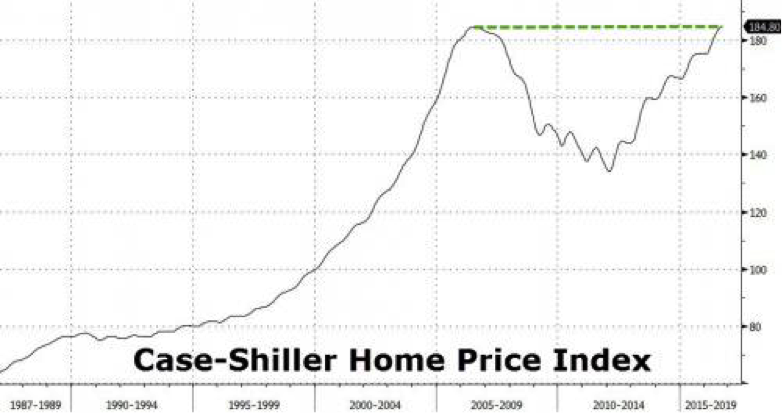
Source: ZeroHedge3
While no investment is without risk, real estate has proven again and again to be a solid choice to invest your money over the long term.
2. Hedge Against Inflation
Inflation is the rate at which the general cost of goods and services rises. As inflation rises, prices go up. This means the money you have in your bank account is essentially worth less because your purchasing power has decreased.
Luckily, real estate prices also rise when inflation increases. That means any money you have invested in real estate will rise with (or often exceed) the rate of inflation. Therefore, real estate is a smart place to put your money to guard against inflation.
3. Cash Flow
One of the big benefits of investing in real estate over the stock market is its ability to provide a fairly steady and predictable monthly cash flow. That is, if you choose to rent out your investment property to a tenant, you can expect to receive a rent payment each month.
If you’ve invested wisely, the rent payment should cover the debt obligation you may have on the property (i.e. mortgage), as well as any repairs and maintenance that are needed. Ideally, the monthly rental income would be great enough to leave you a little extra cash each month, as well. You could use that extra money to pay off the mortgage faster, cover your own household expenses, or save for another investment property.
Even if you only take in enough rent to cover your expenses, a rental property purchase will pay for itself over time. As you pay down the mortgage every month with your rental income, your equity will continue to increase, until you own the property free and clear … leaving you with residual cash flow for years to come.
As the owner, you will also benefit from the property’s appreciation when it comes time to sell. This can be a great way to save for retirement or even fund a child’s college education. Purchase a property when the child is young, and with a little discipline, it can be paid off by the time they are ready to go to college. You can sell it for a lump sum, or use the monthly income to pay their tuition and expenses.
4. Leverage
One of the unique features that sets real estate apart from other asset classes is the ability to leverage your investment. Leverage is the use of borrowed capital to increase the potential return of an investment.
For example, if you purchase an investment property for $100,000, you might put 10% down ($10,000) and borrow the remaining $90,000 in the form of a mortgage.
Even though you’ve only invested $10,000 at this point, you have the ability to earn a profit on the entire $100,000 investment. So, if the property appreciates to $120,000 – a 20% increase over the purchase price – you still only have to pay the bank back the original $90,000 (plus interest) … and you get to keep the $20,000 profit.
That means you made $20,000 off of a $10,000 investment, essentially doubling your money, even though the market only went up by 20%! That’s the power of leverage.
5. Tax Advantages
One of the top reasons to invest in real estate is the tax benefit. There are numerous ways a real estate investment can save you money each year on taxes:
Depreciation
When you record your income from a rental property on your annual tax return, you get to deduct any expenses associated with the investment. This includes interest paid on the mortgage, maintenance, repairs and improvements, but it also includes something called depreciation.
Depreciation is the theoretical loss your property suffers each year due to aging. While it’s true that as a home ages it will structurally need repairs and systems will eventually need to be replaced, we’ve also learned in this post that the value of real estate appreciates over time. So getting to claim a “loss” on your investment that is actually gaining in value makes real estate an appealing investment choice.
Serial Home Selling
Even if you’re not interested in owning a rental property, other types of real estate investments offer tax advantages, as well. Generally, when you own an investment property you pay a capital gains tax on any profits you make when you sell the property.
However, when you sell your principal residence, you are exempt from paying taxes on capital gains (up to $250,000 for singles and $500,000 for couples). The Internal Revenue Service (IRS) only requires that you live in the house for two of the previous five years. That means you can purchase an investment property, live in it while you remodel it, and then sell it for a tax-free profit two years later. This can be a great way to get started in real estate investing.
Section 1031 Exchanges
In addition to profiting off of your personal residence tax free, it is possible to sell an investment property tax free if you do it through a 1031 Exchange. If structured properly, the IRS Tax Code enables an investor to sell a property and reinvest the proceeds in a new property while deferring all capital gains taxes.
Tax-Deferred Retirement Account
It’s a common misconception that you can only purchase financial instruments (i.e. stocks, bonds, mutual funds, etc.) through an Individual Retirement Account (IRA) or 401(k). In actuality, the IRS allows individuals to invest retirement funds in real estate and other alternative types of investments, as well. By purchasing your investment property through an IRA, you can take advantage of all of the tax savings these accounts offer.
Be sure to consult a tax professional regarding all tax matters related to your real estate investments. If structured correctly, the profits you earn on your real estate investments can be largely shielded from tax liability. Just another reason to choose real estate as your preferred investment vehicle.
TYPES OF REAL ESTATE INVESTMENTS
While there are numerous ways to invest in real estate, we’re going to focus on three primary ways average investors earn money through real estate. We touched on several of these already in the previous section.
1. Remodel and Resell
HGTV has countless “reality” shows featuring property flippers who make this investment strategy look easy. Commonly referred to as a “Fix and Flip,” investors purchase a property with the intention of remodeling it in a short period of time, with the hope of selling it quickly for a profit.
This is a higher-risk tactic, and one for which many of the real estate “gurus” we talked about earlier claim to have the magic formula. They promise huge profits in a short amount of time. But investors need to understand the risks involved, and be prepared financially to cover additional expenses that may arise.
Luckily, an experienced real estate agent can help you identify properties that may be good candidates for this type of investment strategy… and help you avoid some of the pitfalls that could derail your plans.
2. Traditional Rental
One of the more conservative choices for investing in real estate is to purchase a rental property. The appeal of a rental property is that you can generate cash flow to cover the expenses, while taking advantage of the property’s long-term appreciation in value, and the tax benefits of investing in real estate. It’s a win-win, and a great way for first-time investors to get started.
And according to the U.S. Bureau of Labor Statistics, rents for primary residences have increased 21.9 percent between 2007 and 2015 as demand for rental units continues to grow.1
3. Short-term Rental
With the huge movement toward a “sharing economy,” platforms that facilitate short-term rentals, like Airbnb and HomeAway, are booming. Their popularity has spurred a growing trend toward dual-purpose vacation homes, which owners use themselves part of the year, and rent out the remainder of the time. There are also a growing number of investors purchasing single-family homes for the sole purpose of leasing them on these sites.
Short-term rentals offer several benefits over traditional rentals, which many investors find attractive, including flexibility and higher profit margins. However, the most profitable properties are strategically located near popular tourist destinations. You’ll need an experienced real estate professional to help you identify the right property if you want to be successful in this highly-competitive market.
DOES REAL ESTATE INVESTING SOUND TOO GOOD TO BE TRUE?
We’ve all heard stories, or maybe even know someone, who struck it rich with a well-timed real estate purchase. However, just like any investment strategy, a high potential for earnings often goes hand-in-hand with an increase in risk. Still, there’s substantial evidence that a well-executed real estate investment can be one of the best choices for your money.
Purchasing a home to remodel and resell can be highly profitable, as long as you have a trusted team in place to complete the remodel quickly and within budget … and the financial means to carry the property for a few extra months if delays occur.
Or, if you buy a house for appreciation and cash flow, you can ride through the market ups and downs without stress because you know your property value is bound to increase over time, and your expenses are covered by your rental income.
In either scenario, make sure you’re working with a real estate agent who has knowledge of the investment market and can guide you through the process. While no investment is without risk, a conservative and well-planned investment in real estate can supplement your income and set you up for future financial security.
If you are considering an investment in real estate, please contact us at 303.475.6269 or john@coloradolifestyleproperties.com to set up a free consultation. We have experience working with all types of investors and can help you determine the best strategy to meet your investment goals.
Sources:
- Bureau of Labor Statistics Consumer Expenditure Survey Annual Report – https://www.bls.gov/opub/reports/consumer-expenditures/2015/home.htm
- S&P Dow Jones Indices Press Release –
https://www.spice-indices.com/idpfiles/spice-assets/resources/public/documents/574349_cshomeprice-release-0829.pdf?force_download=true
- Durden, T. (2016 November 29). US Home Prices Rise Above July 2006 Levels, Hit New Record High [blog post] ZeroHedge –
http://www.zerohedge.com/news/2016-11-29/us-home-prices-rise-above-july-2006-levels-hit-new-record-hig
h
SaveSave